
Spiritual Lineages and Genealogies

Silsilas, or initiatic lineages, occupy a central place in the spiritual traditions of Sufism. They represent the unbroken transmission of spiritual teaching from the Prophet Muhammad ﷺ through successive generations of masters to the guides of the various Sufi orders. As authentic testimonies of spiritual lineage, they embody the continuity of a path founded upon transmission, education, and the pursuit of inner knowledge.

The Fondation ADLANIA’s collection of silsilas and spiritual genealogies brings together calligraphic documents, initiatic trees, and illustrated representations from various Sufi orders across the Muslim world. These works often combine calligraphy, iconography, and ornamentation to preserve the memory of the masters and to make visible the chain of transmission that connects each spiritual path to its prophetic source.

Beyond their historical and artistic significance, these documents bear witness to the importance of transmitting spiritual knowledge within Muslim societies. Through this collection, the Fondation ADLANIA contributes to the preservation and promotion of an exceptional heritage at the crossroads of religious history, Islamic calligraphy, and the living memory of the Sufi brotherhoods.

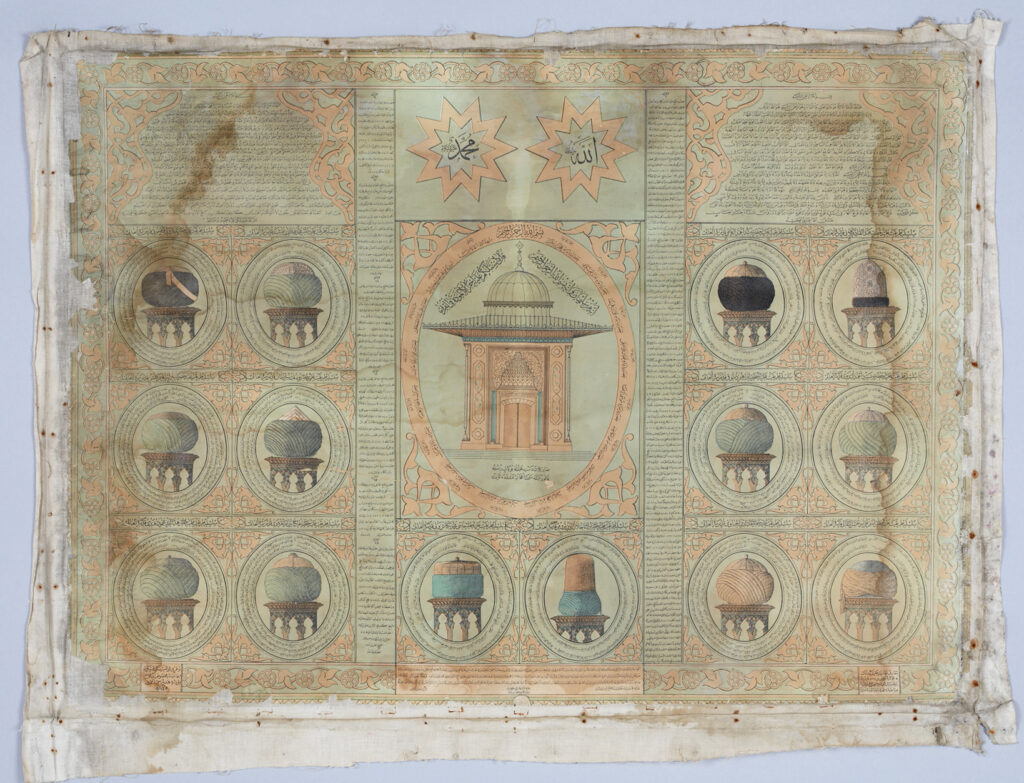
Tree of the Branches of the Mawlawiyya Order

ICO 1343

This document presents the various branches of the Mawlawiyya (Mevlevi) Sufi order, founded on the teachings of Jalāl al-Dīn Rūmī (1207–1273). At the center of the composition stands Rūmī’s mausoleum in Konya, while the surrounding cartouches depict the distinctive turbans and headdresses associated with the order’s different lineages and functions. Each head covering serves as a distinctive emblem, identifying affiliation with a particular branch or rank within the order. Combining calligraphy, symbolic representation, and descriptions of ceremonial attire, this work highlights the importance of initiatic traditions and visual markers of identity in the organization of Sufi brotherhoods.

Estimated date: Late 19th – early 20th century.
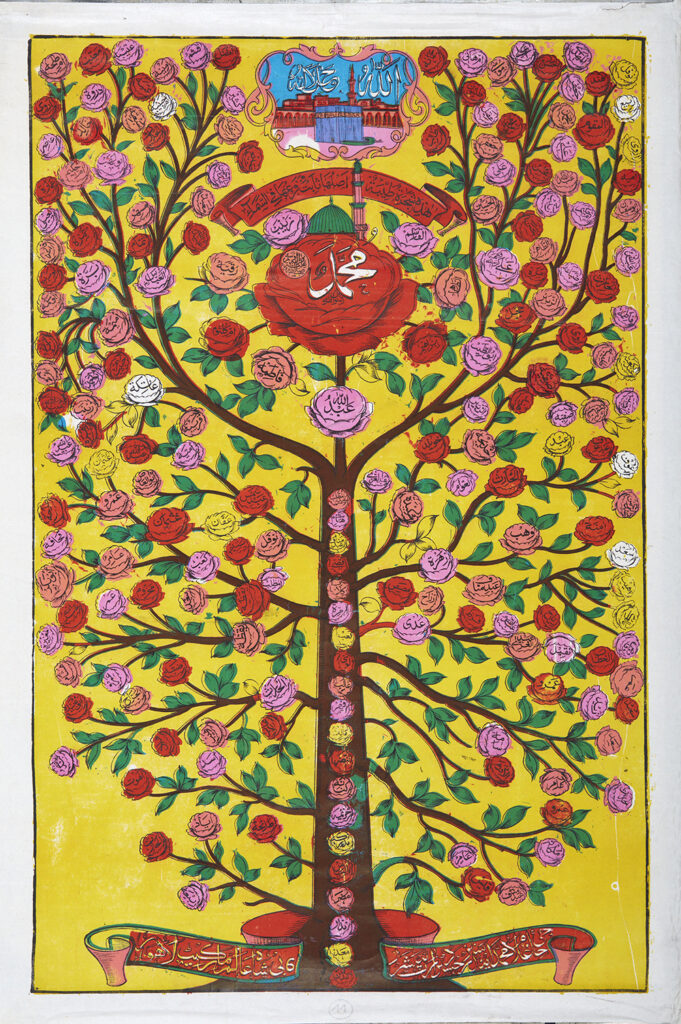
Genealogical Tree of the Ahl al-Bayt

ICO 228

This tree diagram illustrates the genealogy of the Ahl al-Bayt, the Family of the Prophet Muhammad ﷺ. Arranged in the form of a flowering tree, the composition depicts the Prophet’s ancestors, descendants, and the principal figures of the Prophetic Household, whose names are inscribed within the blossoms adorning its branches. At the top of the tree appears the name of the Prophet Muhammad ﷺ, accompanied by a symbolic representation of Medina and the Prophet’s Mosque. Through its rich floral decoration and genealogical structure, this work commemorates the memory of the Prophetic Family and stands as a remarkable testament to the significance of spiritual lineages in the Islamic tradition.

Estimated date: Late 19th – early 20th century.
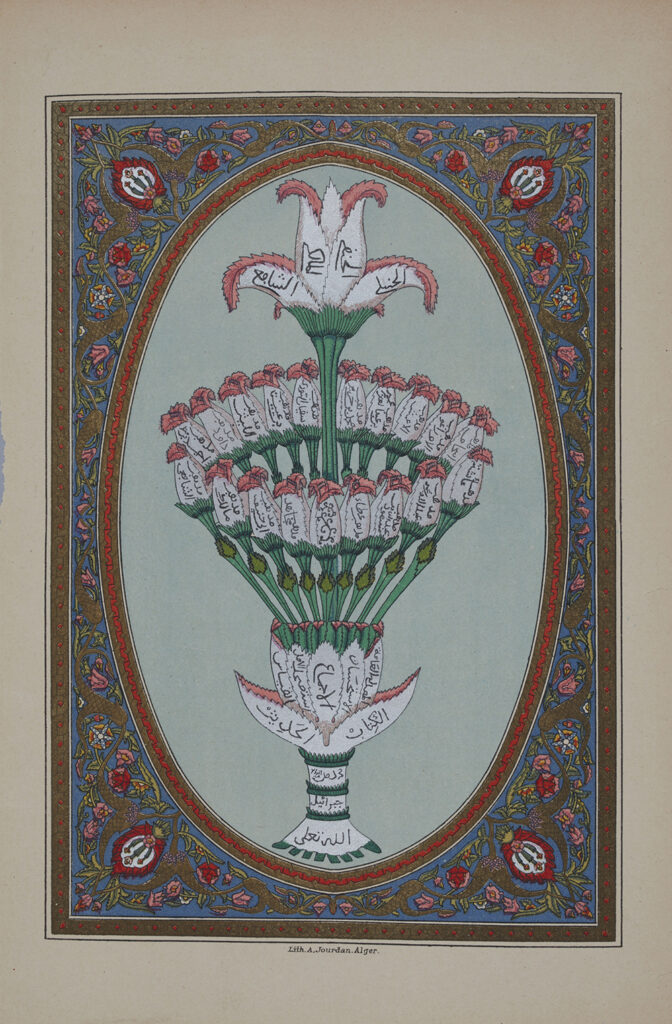
Tree of the Islamic Schools of Jurisprudence

ICO 381

This symbolic representation depicts the principal schools of Islamic jurisprudence in the form of a floral bouquet. Emerging from a common source at the base of the composition, the various branches lead to the major traditions of *fiqh*, including the Hanafi, Maliki, Shafi‘i, and Hanbali schools, as well as other legal traditions represented by the flowers that complete the composition. Through its harmonious organization and refined floral decoration, this work illustrates the diversity of legal interpretations developed within Islamic civilization while emphasizing their common roots in a shared religious tradition. It stands as a remarkable testimony to the ways in which religious knowledge was transmitted, organized, and visually represented in the graphic arts of the Islamic world.

Estimated date: Late 19th – early 20th century.
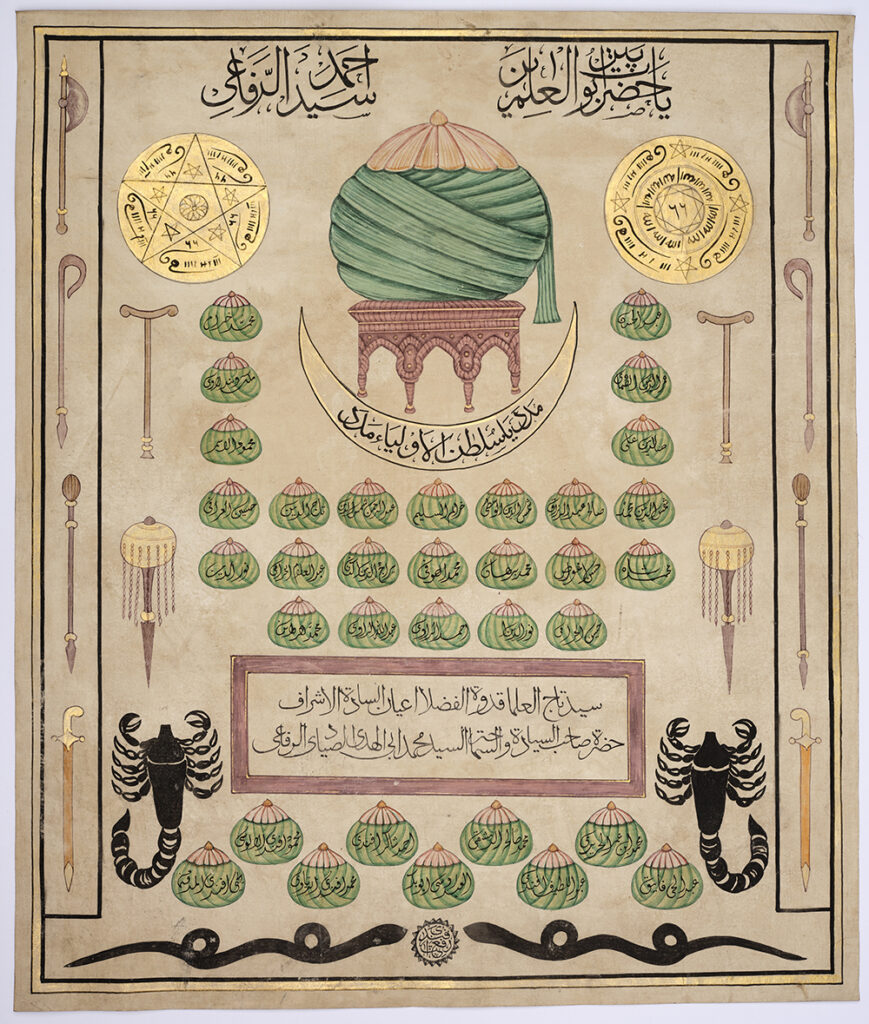
Silsila of the Rifāʿiyya Order

ICO 589

This calligraphic and symbolic representation is dedicated to the Rifāʿiyya Sufi order, founded by the Sufi master Aḥmad al-Rifāʿī (1118–1182). At the center of the composition appears the emblematic turban associated with the founder of the order, surrounded by the names of his principal successors and spiritual representatives. The work also incorporates several symbols characteristic of the Rifāʿī tradition, including weapons, banners, and scorpion figures, alluding to certain ascetic practices and expressions of devotion that contributed to the order’s renown. Through its hierarchical arrangement, this document illustrates the transmission of spiritual teaching within the Rifāʿiyya and preserves the memory of the masters who ensured its spread throughout the Muslim world.

Estimated date: Late 19th – early 20th century.
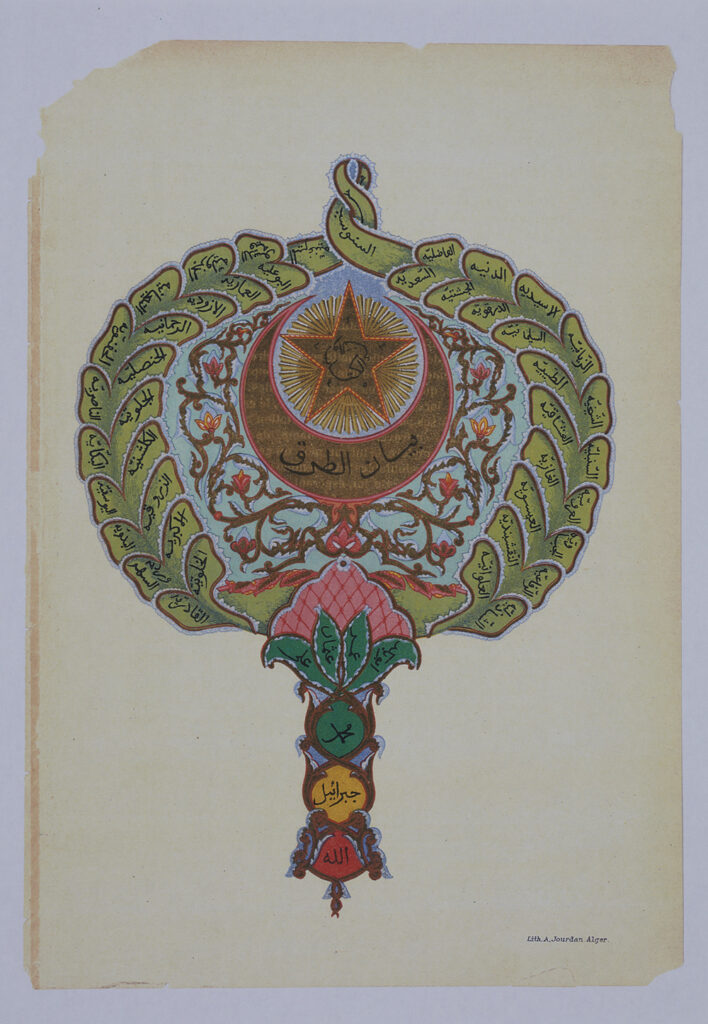
Bayān al-Ṭuruq – Tree of the Sufi Orders

ICO 378

This lithograph, entitled Bayān al-Ṭuruq (“Exposition of the Spiritual Paths”), depicts the principal Sufi orders of the Muslim world in the symbolic form of a tree. From the spiritual source represented at the base of the composition emerge the various initiatic paths, including the Qādiriyya, Shādhiliyya, Khalwatiyya, Bektāshiyya, ʿĪsāwiyya, and many other Sufi orders. The work illustrates the diversity of Sufi traditions while emphasizing their common origin and shared spiritual heritage. Through its combination of calligraphy, floral ornamentation, and arboreal imagery, this document stands as a remarkable testimony to the history of Sufi brotherhoods and the transmission of spiritual knowledge throughout the Islamic world.

Estimated date: Late 19th – early 20th century.
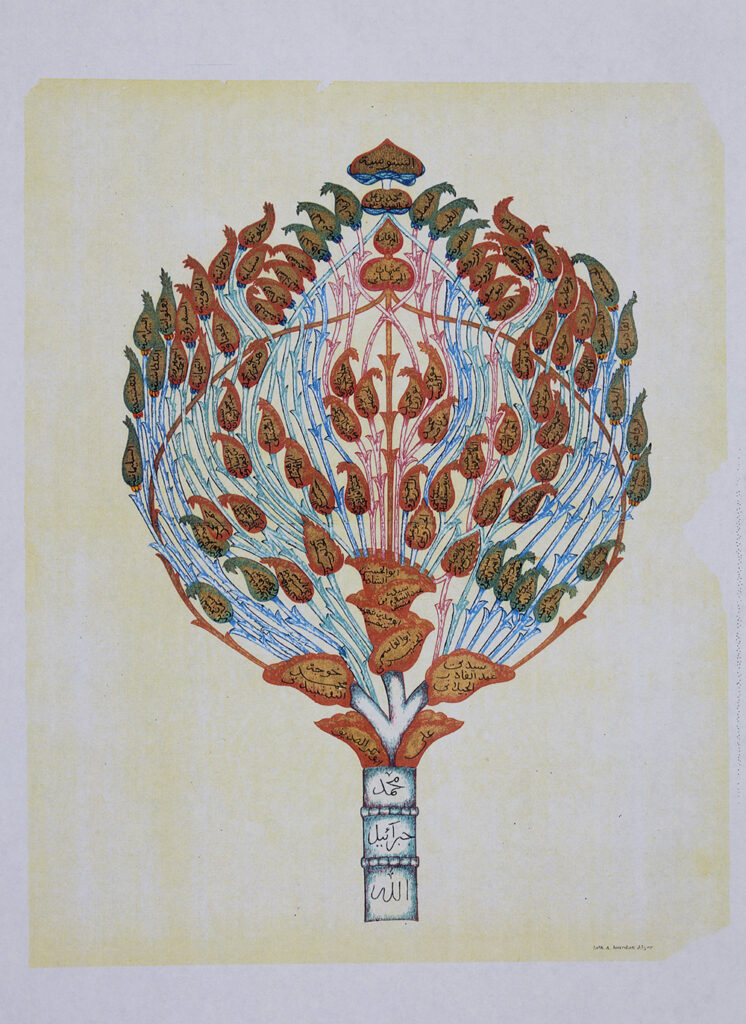
Tree of Sufi Orders and Masters

ICO 379

This tree-like representation illustrates the principal Sufi orders through their founders and spiritual lineages. At the center of the composition are several eminent masters who profoundly shaped the history of Sufism, including ʿAbd al-Qādir al-Jīlānī, Bahāʾ al-Dīn al-Naqshbandī, and Abū ʿAbd Allāh al-Jazūlī, whose teachings gave rise to numerous spiritual branches. The branches extend to the various Sufi orders that developed throughout the Muslim world, forming a veritable map of the initiatic traditions of Sufism. Through its symbolic tree structure, this work highlights the bonds of spiritual descent, transmission, and inheritance that unite the different paths to a common source.

Estimated date: Late 19th – early 20th century.

Legal Information

Intellectual Property

All content available on this website, including but not limited to texts, photographs, manuscripts, images, illustrations, videos, digitized documents, logos, databases, graphic elements, and other materials, is protected under Swiss and international copyright and intellectual property laws.

Except with the prior written authorization of the ADLANIA Foundation or the relevant rights holders, any reproduction, representation, distribution, adaptation, or exploitation, whether in whole or in part, of this content, by any means or on any medium whatsoever, is prohibited.

The reproductions of the works and documents presented on this website are made available exclusively for purposes of preservation, research, scientific, cultural, and heritage enhancement.

Collections and Archives

The manuscripts, documents, photographs, heritage objects, works of art, and other collections presented on this website are owned by the ADLANIA Foundation or are reproduced with the authorization of their owners or rights holders.

The manuscripts, documents, photographs, heritage objects, works, and other collections presented on this website are owned by the ADLANIA Foundation or are reproduced with the authorization of their owners or rights holders.

Collection Photographs

The photographs of the manuscripts, objects, works of art, and other heritage items presented on this website were taken by photographer Abdou Diouri as part of his collaboration with the ADLANIA Foundation.

These photographs are protected by copyright.

Any reproduction, display, distribution, modification, or use, whether in whole or in part and in any form whatsoever, is prohibited without the prior written authorization of the ADLANIA Foundation and, where applicable, the relevant rights holders.

Privacy Policy

The ADLANIA Foundation is committed to protecting the personal data of visitors to this website. The information collected through contact forms, information requests, registrations, or orders is used exclusively to respond to users' inquiries, manage communications, process orders, and improve the services provided.

Personal data is neither sold, rented, nor disclosed to third parties, except where required by law or when necessary for the provision of a service requested by the user.

In accordance with applicable data protection legislation, each user has the right to access, rectify, erase, restrict the processing of, and, where applicable, object to the processing of their personal data.

Any request may be addressed to the ADLANIA Foundation using the contact details provided on the website.

Cookie Policy

This website uses cookies to ensure its proper functioning, enhance the browsing experience, and, where applicable, measure website traffic.

Strictly necessary cookies required for the operation of the website are placed automatically. Other categories of cookies, including those used for audience measurement or provided by third-party services, are only used after the user's consent has been obtained, where required by applicable law.

The user may, at any time, manage or withdraw their consent through their browser settings or via the cookie consent manager, where available.

Legal Information

Intellectual Property

All content available on this website, including but not limited to texts, photographs, manuscripts, images, illustrations, videos, digitized documents, logos, databases, graphic elements, and other materials, is protected under Swiss and international copyright and intellectual property laws.

Except with the prior written authorization of the ADLANIA Foundation or the relevant rights holders, any reproduction, representation, distribution, adaptation, or exploitation, whether in whole or in part, of this content, by any means or on any medium whatsoever, is prohibited.

The reproductions of the works and documents presented on this website are made available exclusively for purposes of preservation, research, scientific, cultural, and heritage enhancement.

Collections and Archives

The manuscripts, documents, photographs, heritage objects, works of art, and other collections presented on this website are owned by the ADLANIA Foundation or are reproduced with the authorization of their owners or rights holders.

The manuscripts, documents, photographs, heritage objects, works, and other collections presented on this website are owned by the ADLANIA Foundation or are reproduced with the authorization of their owners or rights holders.

Collection Photographs

The photographs of the manuscripts, objects, works of art, and other heritage items presented on this website were taken by photographer Abdou Diouri as part of his collaboration with the ADLANIA Foundation.

These photographs are protected by copyright.

Any reproduction, display, distribution, modification, or use, whether in whole or in part and in any form whatsoever, is prohibited without the prior written authorization of the ADLANIA Foundation and, where applicable, the relevant rights holders.

Privacy Policy

The ADLANIA Foundation is committed to protecting the personal data of visitors to this website. The information collected through contact forms, information requests, registrations, or orders is used exclusively to respond to users' inquiries, manage communications, process orders, and improve the services provided.

Personal data is neither sold, rented, nor disclosed to third parties, except where required by law or when necessary for the provision of a service requested by the user.

In accordance with applicable data protection legislation, each user has the right to access, rectify, erase, restrict the processing of, and, where applicable, object to the processing of their personal data.

Any request may be addressed to the ADLANIA Foundation using the contact details provided on the website.

Cookie Policy

This website uses cookies to ensure its proper functioning, enhance the browsing experience, and, where applicable, measure website traffic.

Strictly necessary cookies required for the operation of the website are placed automatically. Other categories of cookies, including those used for audience measurement or provided by third-party services, are only used after the user's consent has been obtained, where required by applicable law.

The user may, at any time, manage or withdraw their consent through their browser settings or via the cookie consent manager, where available.