Chechias and Headwear

Chechias and traditional headdresses hold a particular place in the dress and cultural history of the societies of the Maghreb and the Muslim world. Beyond their clothing function, these head coverings bear witness to artisanal traditions, regional identities, and social and spiritual practices passed down through generations.

In certain Sufi traditions, headdresses also carry a symbolic and identity-related dimension. Their shape, colour, and ornaments may be associated with membership in a spiritual path, its practices, and its traditions. Some Sufi brotherhoods have thus developed distinctive head coverings, sometimes bearing meanings linked to initiatory transmission and to the relationship between master and disciple.

The diversity of these objects reflects the richness of craftsmanship associated with textiles, fibres, and natural materials. Techniques of braiding, sewing, embroidery, and ornamentation bear witness to artisanal traditions specific to different regions and communities.

Through this selection, the ADLANIA Foundation seeks to highlight headdresses and head coverings that testify to the diversity of dress and spiritual traditions, while contributing to the preservation and promotion of this material heritage.

Sufi cap embroidered with devotional inscriptions

OBJ 3072

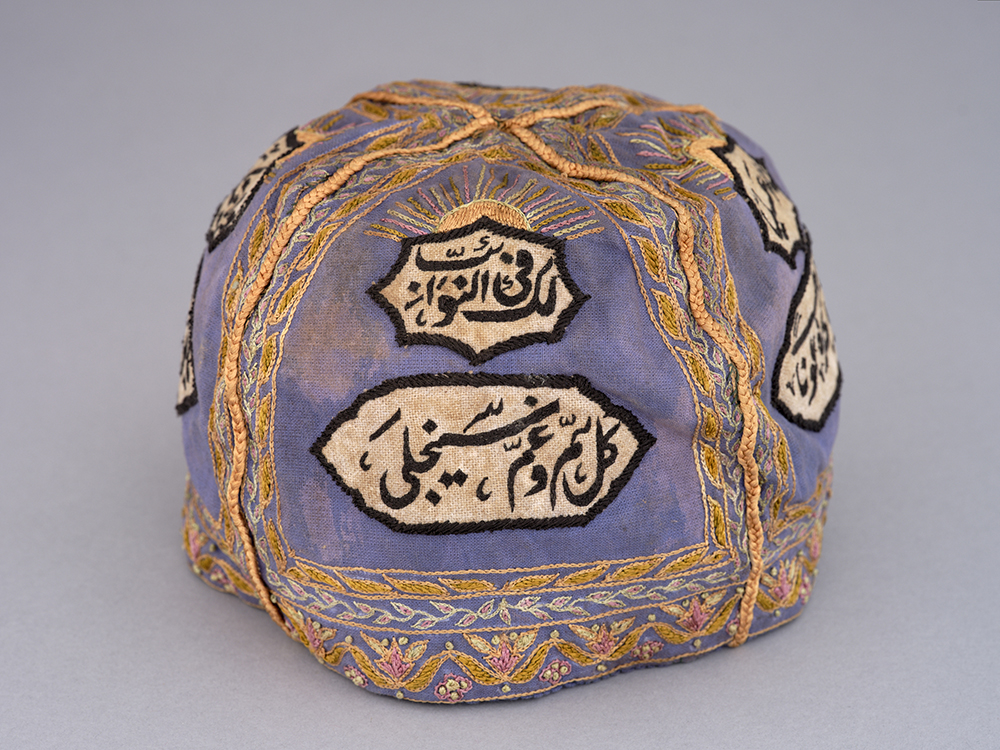
This blue-violet textile cap features particularly rich ornamentation, arranged in embroidered panels and bordered by decorative cords. Floral and geometric motifs, executed in gold, pink, and green threads, run across the surface and accentuate the edges. Several light-fabric cartouches bear Arabic inscriptions embroidered in black, making calligraphy the central element of its decoration.

The inscriptions evoke devotion to Ali ibn Abi Talib and notably include the phrase “يا علي، يا علي، ولايتك” (“O Ali, O Ali, your walāya [your spiritual proximity or authority]”). Another side features a passage from the Nād-e ʿAlī invocation, known for its appeal to Ali in times of hardship: “نادِ عليًّا مظهرَ العجائب، تجده عونًا لك في النوائب”. The ensemble thus combines textile ornamentation and expressions of devotion, within a tradition where the headdress also serves as a medium for spiritual transmission.

Geographic origin: Iran.
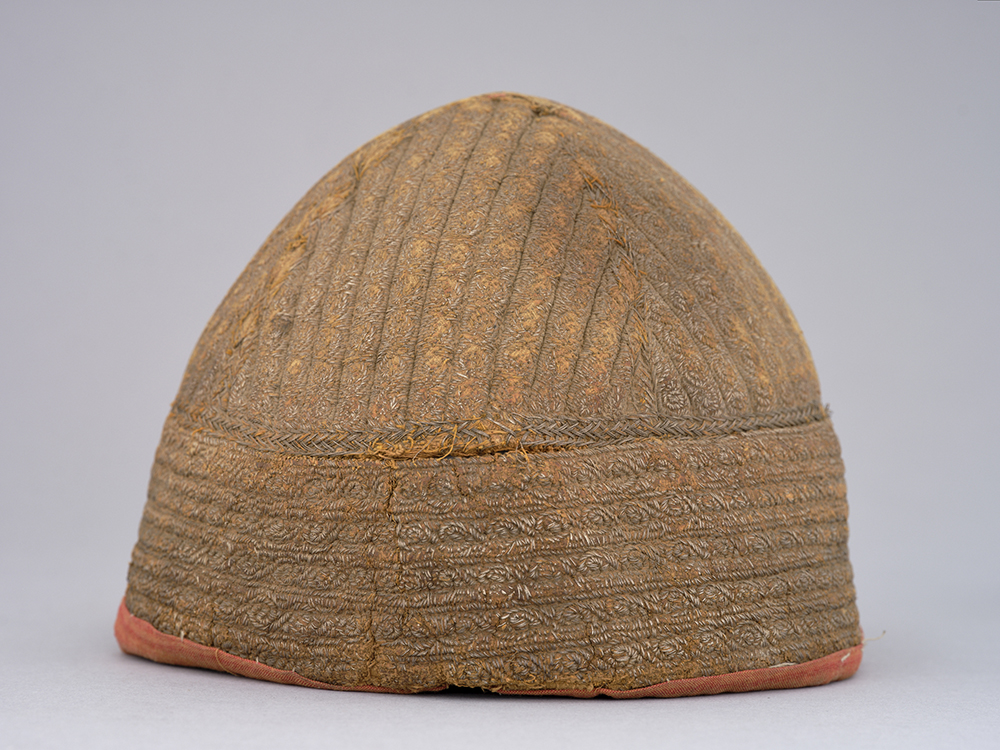
Headdress of a Sufi Master

OBJ 136

This headdress is characterized by a rounded shape and a high crown, crafted using a technique of assembling fibers worked in regular rows. Its structure is accentuated by a horizontal braided band that marks the separation between the upper and lower sections of the object. An orange-red textile border finishes the outer edge.

The regularity of the fiberwork and the arrangement of the elements bear witness to skilled craftsmanship. Worn by a Sufi master, this headdress belongs to the tradition of headwear associated with spiritual figures. It thus represents material evidence of the vestimentary practices and traditions specific to Sufi circles.

Estimated date: 18th century

Geographical provenance: Damascus, Syria

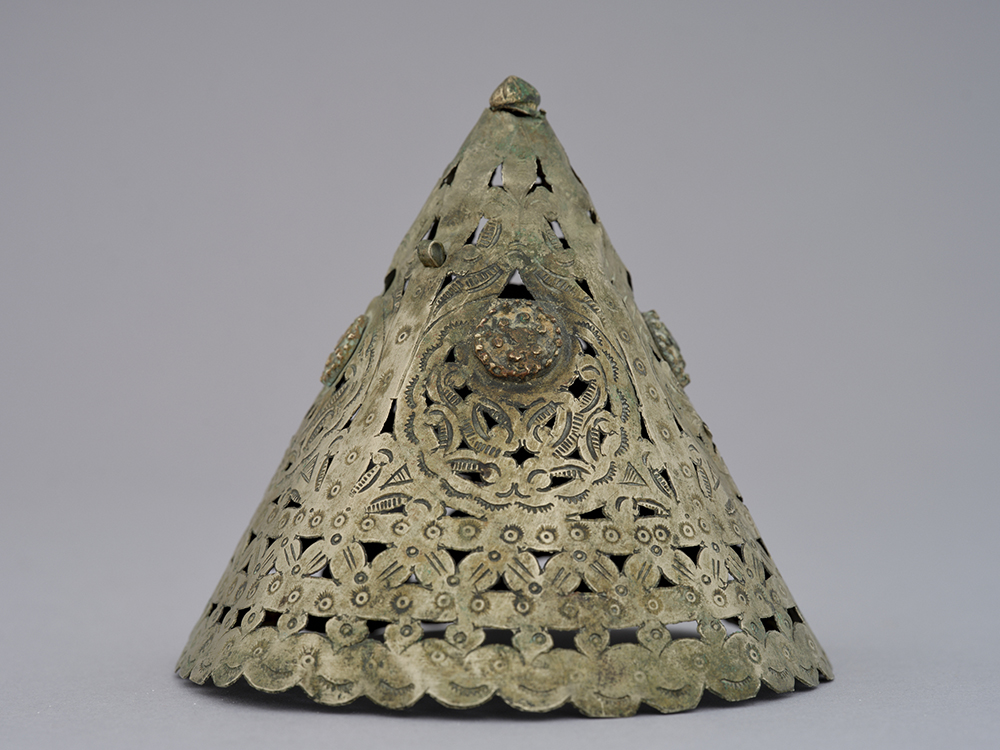
Tāj Chéchia – Conical Jewish headpiece in openwork metal

OBJ 2215

Known as the Tāj Chéchia, this headpiece is characterized by its conical shape and finely crafted metallic structure. The surface is adorned with cut and chased motifs, combining geometric compositions, flowers, and botanical elements. Openwork apertures alternate with decorative reliefs that lend the piece great ornamental richness. The apex is finished with a small decorative sphere surrounded by beads. This headpiece, belonging to the Jewish vestimentary tradition of Algeria, bears witness to the mastery of metal cutting and chasing techniques at the end of the 19th century.

Dating: Late 19th century.
Geographical provenance: Algeria.

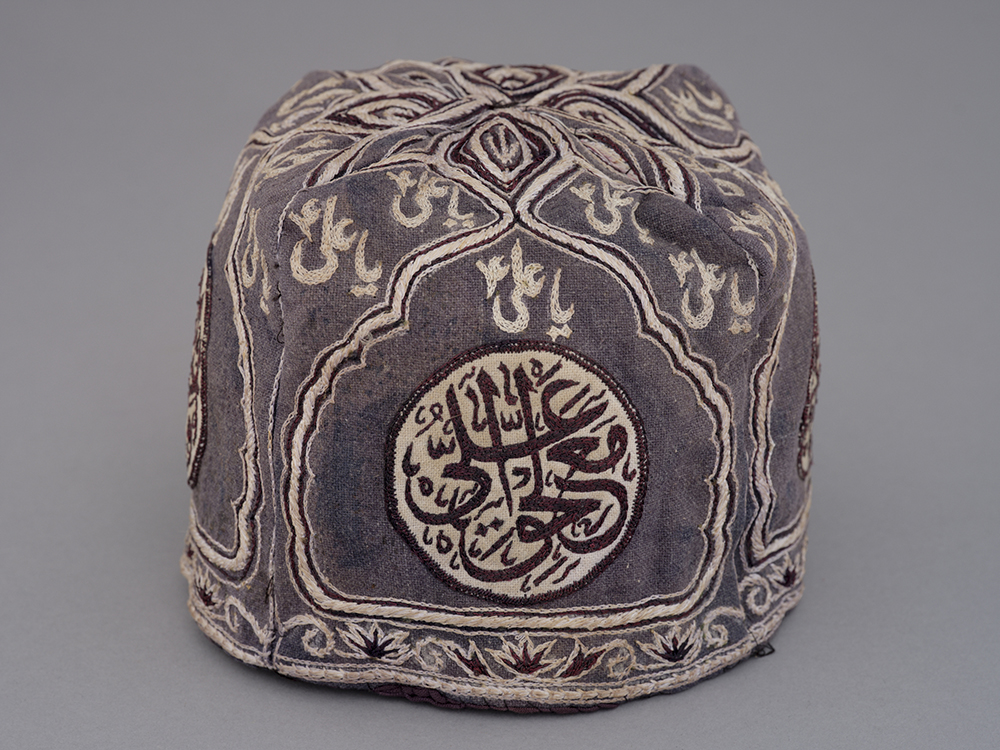
Headdress of the Naqshbandiyya Order

OBJ 3173

Set against a brownish-grey textile background, this headdress features a decorative composition organized into panels bordered by light and burgundy embroidery. In the center, a circular medallion houses a calligraphic inscription, while the surrounding panels are adorned with repeated epigraphic motifs. The top is decorated with interlaced geometric and floral shapes, extended by a vegetal frieze that highlights the lower edge. The whole piece bears witness to meticulous embroidery and calligraphy work, in which the ornamentation accompanies the spiritual identity of the Naqshbandiyya brotherhood. This piece belongs to the tradition of dervish headdresses, called kolāh-e darvish in Persian.

In the center, a circular medallion houses the calligraphic inscription علي مع الحق (“Ali is with the Truth”), a formula expressing the bond between Ali ibn Abi Talib and the Truth (al-Ḥaqq).

Geographic origin: Iran.

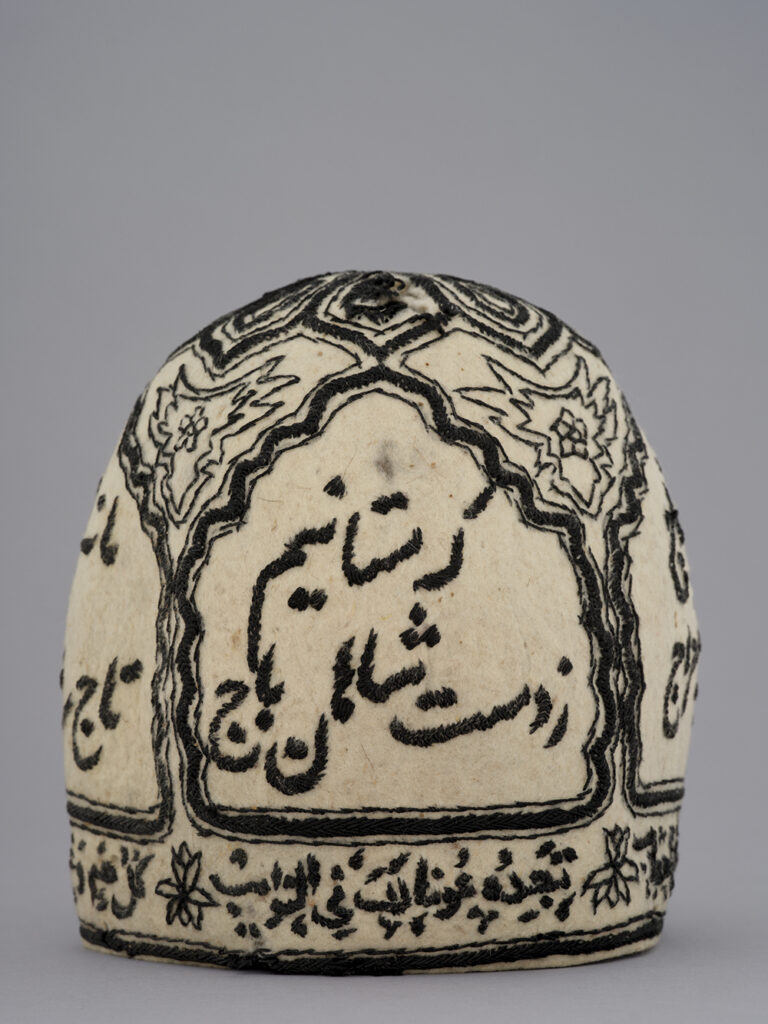
Khāksār Sufi headgear

OBJ 2352

Made of white felt, this headgear is distinguished by its rounded shape and its embroidered panels that rise from the crown in elongated compartments with cut-out outlines. A decoration in black thread covers its surface, combining calligraphic inscriptions, floral motifs, and geometric compositions. At the centre is the prayer known as Nād-e ʿAlī (“Call upon Ali”), an invocation addressed to Ali ibn Abi Talib, cousin and son-in-law of the Prophet Muhammad, to whom a particular place is accorded in the Shiite tradition. Other inscriptions and calligraphic ornaments run along the side panels and the lower border. This headgear belongs to the clothing tradition of the dervishes of the Khāksār order, an Iranian Sufi movement whose practices and representations draw in particular on the traditions of the qalandars and the Malāmatiyya. Its distinctive form, inherited from models that appeared in the Safavid period, seems to have developed in this configuration over the course of the 19th century.

Date: 19th century – early 20th century.
Geographic origin: Iran.

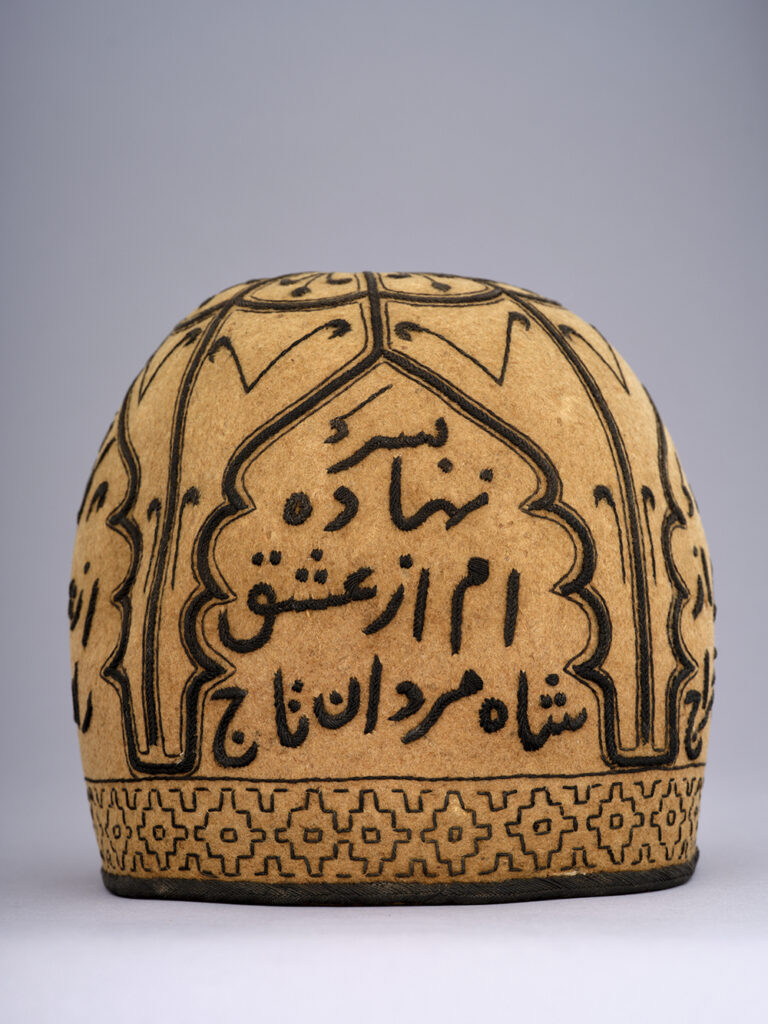
Sufi Headgear from Damascus

OBJ 148

Crafted from ochre-colored felt, this Sufi headgear is distinguished by its decorative motifs embroidered with black thread in geometric and ornamental patterns. Its composition is structured around decorative panels delineated by embroidered lines, which frame a Persian inscription occupying the central section. A repetitive geometric frieze adorns the base of the headgear, underscoring the meticulous craftsmanship of its execution.

The inscription, which appears to read “For love of the King of Men, I have placed no crown upon my head,” refers to Shāh-e Mardān (شاه مردان), “the King of Men,” a spiritual and poetic title associated with Ali ibn Abi Talib. It expresses a form of devotion in which love for Ali supersedes all earthly distinction or rank. This inscription imparts an initiatic and spiritual dimension to the headgear, bearing witness to the central role that Persian poetry, spiritual love, and devotion to Ali hold within certain Sufi traditions.

Estimated date: 19th century

Geographical origin: Damascus, Syria

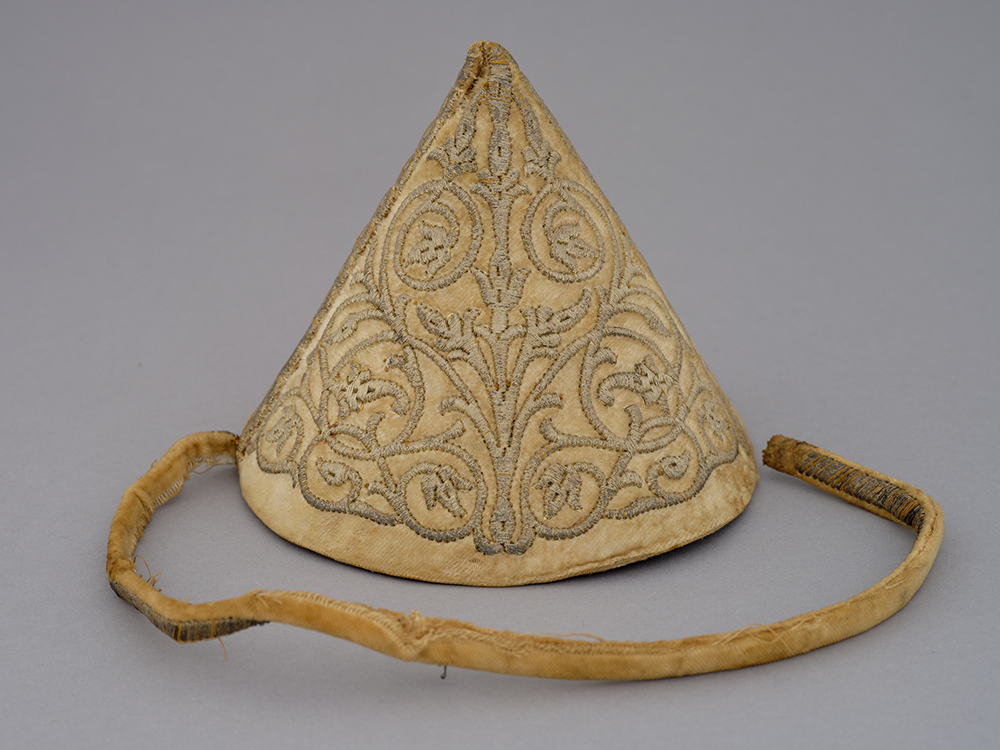
Traditional Embroidered Headdress

OBJ 2218

Conical and slightly curved in shape, this headdress is crafted from a light beige fabric. Its surface is embellished with tone-on-tone embroidery worked in gold thread, forming a symmetrical design of scrollwork, floral motifs, and circular shapes. The embroidery extends from the tip down to the base, where it culminates in an exceptionally elaborate botanical composition. Two fabric side ties secure the headdress in place. The subdued color palette contrasts with the richness of the embroidery, showcasing the exquisite refinement of traditional textile ornamentation.

Date: Late 19th century.
Geographic origin: Algeria.

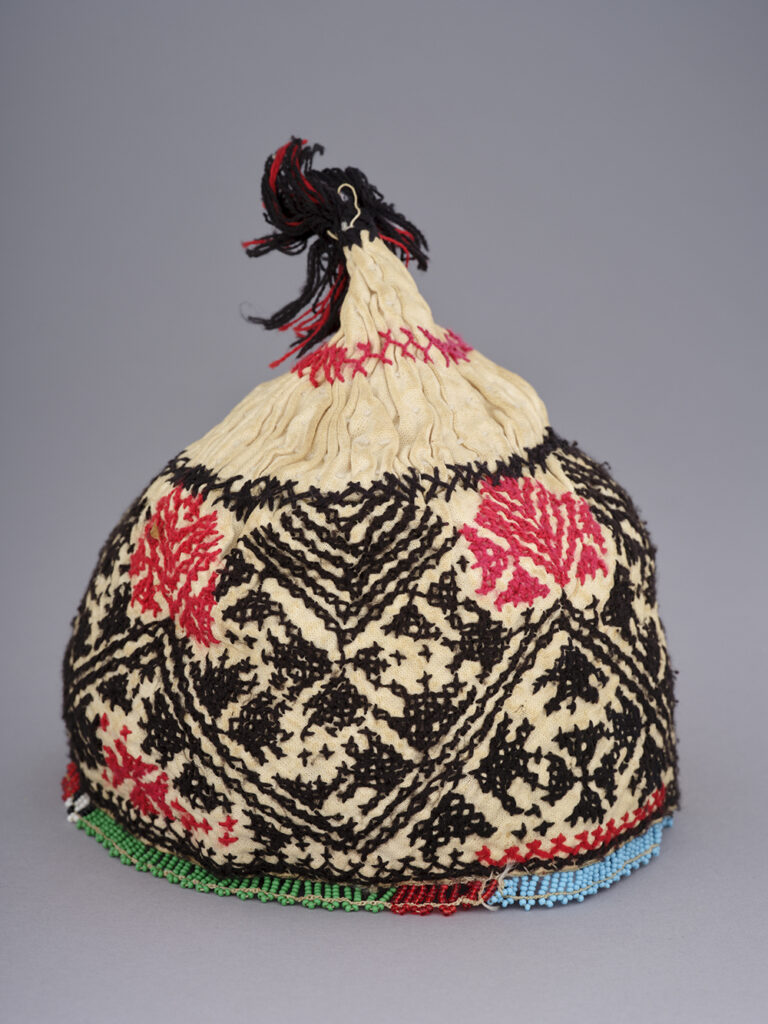
Mawlawiyya Chechia

OBJ 1057

The silhouette of this chechia is characterized by a rounded skullcap, gathered at the top into a narrow section from which a tuft of black and red threads emerges. The unbleached fabric is entirely adorned with black and red thread embroidery, creating a dense pattern of geometric and botanical motifs. At the base, several rows of small green, red, and blue beads form a colorful border highlighting the headdress’s contour. Associated with the Mawlawiyya tradition of Konya, this piece reflects the meticulous care given to adornment and ornamentation within the vestimentary traditions of this Sufi order.

Geographical origin: Konya, Turkey.

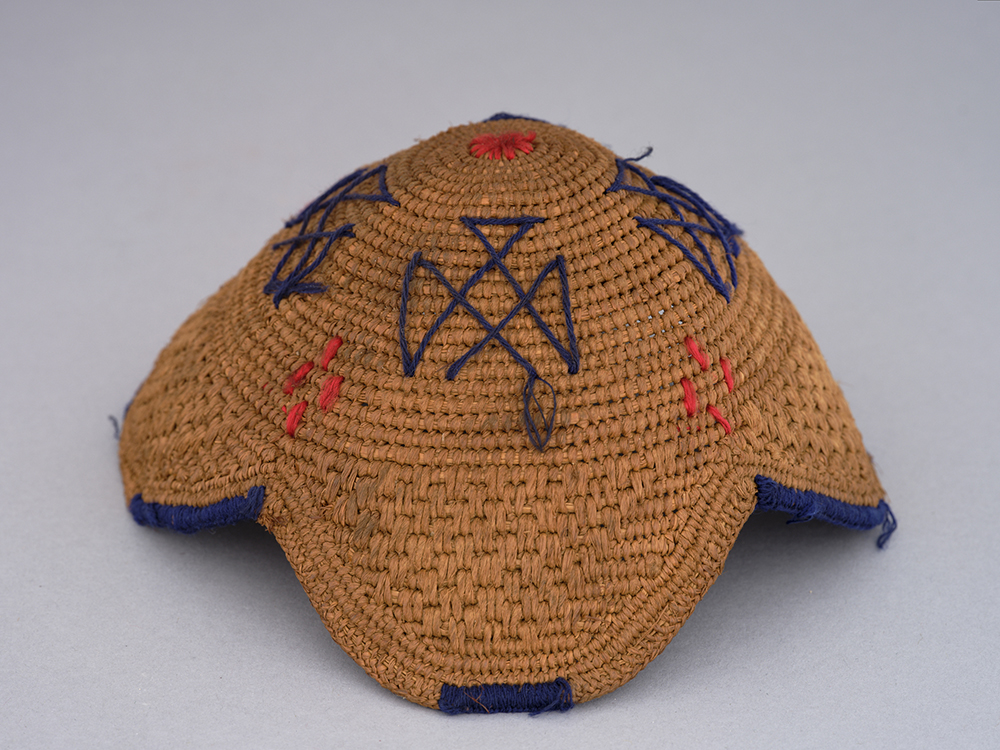
Traditional Kuba headdress with geometric patterns

OBJ 205

This headdress is distinguished by its structure of woven plant fibers, forming a circular cap extended by several panels integrated into its composition. Its decoration combines geometric motifs embroidered in dark blue thread with touches of red arranged symmetrically. The top is marked by a small circular red ornament, while the edges of the panels are highlighted with a blue finish.

The combination of weaving and embroidery reflects the richness of the Kuba people’s textile craftsmanship, whose artisanal productions are notably characterized by the diversity of geometric compositions and the meticulous working of fibers. This headdress illustrates the importance placed on ornamentation and the mastery of textile techniques in Kuba material culture.

Geographic origin: Congo, Kasai region.

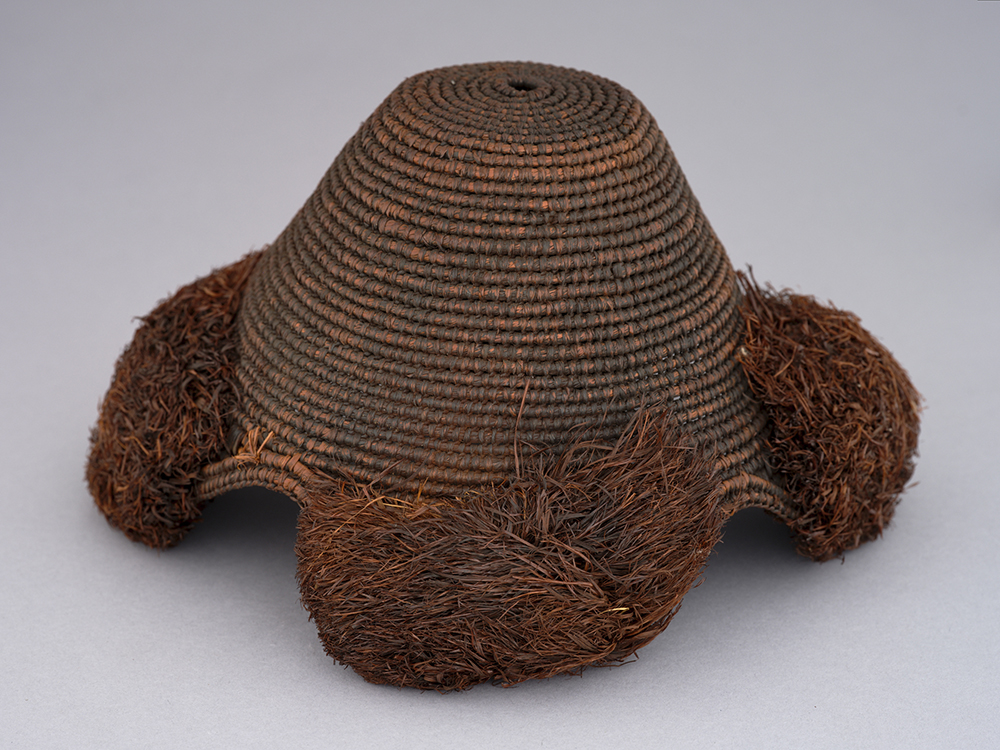
Kuba prestige headdress

OBJ 209

This headdress is characterized by a conical crown made of woven plant fibers using a regular and tight basketry technique. Its lower part is extended by a voluminous border consisting of long, dense fibers, creating a sharp contrast with the compact structure of the crown. The combination of these two textures gives the object a unique silhouette and a remarkable visual presence.

This piece exhibits characteristics similar to certain prestige headdresses of the Kuba people, notably the model known as Laket Mishiing. In Kuba culture, prestige headdresses contribute to the expression of social status and the rank of their wearers. Their creation involves various materials and artisanal techniques, reflecting the importance placed on adornment and representation in the traditions of this society.

Geographical origin: Congo, Kasaï region.

Ottoman fez embroidered with calligraphic inscriptions

OBJ 3075

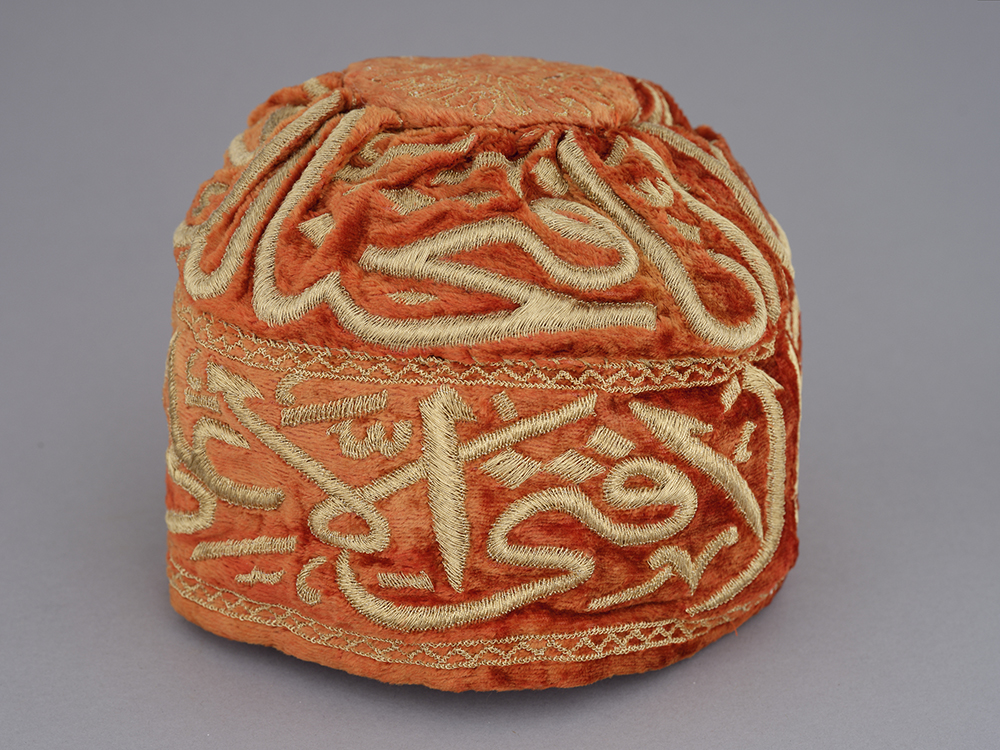
The orange background of this chechia is entirely enhanced with gold embroidery, forming large calligraphic inscriptions that occupy both the crown and the lower part. On the top is the Quranic verse: إِنَّا فَتَحْنَا لَكَ فَتْحًا مُبِينًا (“We have granted you a clear victory”), extracted from Surah Al-Fath (XLVIII, 1). The lower part bears the famous formula: لا فتى إلا علي، ذو الفقار (“There is no hero but Ali, no sword but Zulfiqar”), which associates the figure of Ali ibn Abi Talib with his legendary sword. The richness of the embroidery and the scale of the characters give this headdress a strong calligraphic and devotional dimension, where Quranic references sit alongside the spiritual tradition linked to Ali.

Geographical provenance: Ottoman world..

Traditional headdress adorned with metal pieces

OBJ 1238

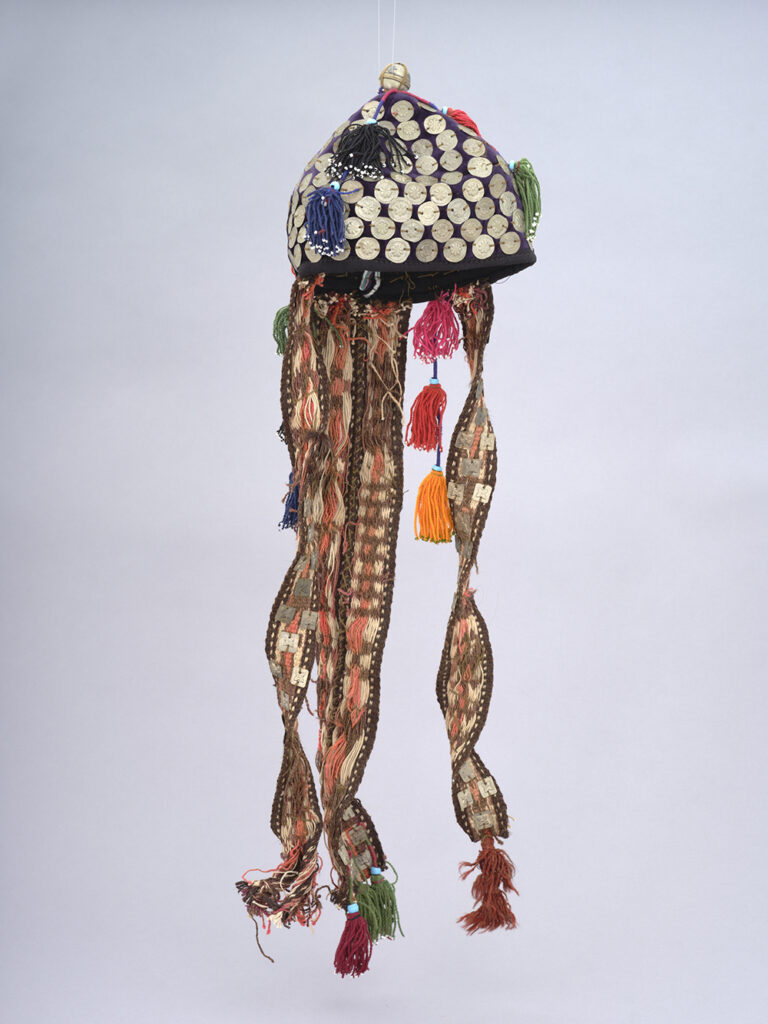
This headdress consists of a domed skullcap covered with numerous small circular metal pieces arranged in regular rows. At its top, a spherical ornament is accompanied by tassels of coloured threads. Long polychrome textile braids extend the skullcap and fall in several panels, combining brown, red, orange and green threads. They are punctuated with small metal pieces and multicoloured tassels that enhance the whole. The combination of applied metal elements, braiding and textile ornaments gives this headdress a particularly elaborate composition, characteristic of traditional adornment craftsmanship.

Geographical origin : Armenia.

Legal Information

Intellectual Property

All content available on this website, including but not limited to texts, photographs, manuscripts, images, illustrations, videos, digitized documents, logos, databases, graphic elements, and other materials, is protected under Swiss and international copyright and intellectual property laws.

Except with the prior written authorization of the ADLANIA Foundation or the relevant rights holders, any reproduction, representation, distribution, adaptation, or exploitation, whether in whole or in part, of this content, by any means or on any medium whatsoever, is prohibited.

The reproductions of the works and documents presented on this website are made available exclusively for purposes of preservation, research, scientific, cultural, and heritage enhancement.

Collections and Archives

The manuscripts, documents, photographs, heritage objects, works of art, and other collections presented on this website are owned by the ADLANIA Foundation or are reproduced with the authorization of their owners or rights holders.

The manuscripts, documents, photographs, heritage objects, works, and other collections presented on this website are owned by the ADLANIA Foundation or are reproduced with the authorization of their owners or rights holders.

Collection Photographs

The photographs of the manuscripts, objects, works of art, and other heritage items presented on this website were taken by photographer Abdou Diouri as part of his collaboration with the ADLANIA Foundation.

These photographs are protected by copyright.

Any reproduction, display, distribution, modification, or use, whether in whole or in part and in any form whatsoever, is prohibited without the prior written authorization of the ADLANIA Foundation and, where applicable, the relevant rights holders.

Privacy Policy

The ADLANIA Foundation is committed to protecting the personal data of visitors to this website. The information collected through contact forms, information requests, registrations, or orders is used exclusively to respond to users' inquiries, manage communications, process orders, and improve the services provided.

Personal data is neither sold, rented, nor disclosed to third parties, except where required by law or when necessary for the provision of a service requested by the user.

In accordance with applicable data protection legislation, each user has the right to access, rectify, erase, restrict the processing of, and, where applicable, object to the processing of their personal data.

Any request may be addressed to the ADLANIA Foundation using the contact details provided on the website.

Cookie Policy

This website uses cookies to ensure its proper functioning, enhance the browsing experience, and, where applicable, measure website traffic.

Strictly necessary cookies required for the operation of the website are placed automatically. Other categories of cookies, including those used for audience measurement or provided by third-party services, are only used after the user's consent has been obtained, where required by applicable law.

The user may, at any time, manage or withdraw their consent through their browser settings or via the cookie consent manager, where available.