Qur'ans

The manuscripts of the Qur’an constitute one of the most precious legacies of Islamic civilization. From the earliest centuries of Islam, the faithful transmission of the revealed text gave rise to an exceptionally rich manuscript tradition, in which the rigorous practice of copying gradually evolved alongside the remarkable development of the arts of the book, calligraphy, and illumination.

Carefully preserved and passed down from generation to generation, these manuscripts bear witness to the diversity of calligraphic styles, artistic schools, and craftsmanship that flourished across the various regions of the Muslim world. Produced on parchment or paper, they reflect both the history of the transmission of the Qur’anic text and the evolution of the techniques of copying, bookbinding, and ornamentation.

Through this collection, the ADLANIA Foundation seeks to preserve, study, and promote this exceptional heritage, where the beauty of script, the mastery of the book arts, and the living memory of the transmission of the Qur’an come together across the centuries.

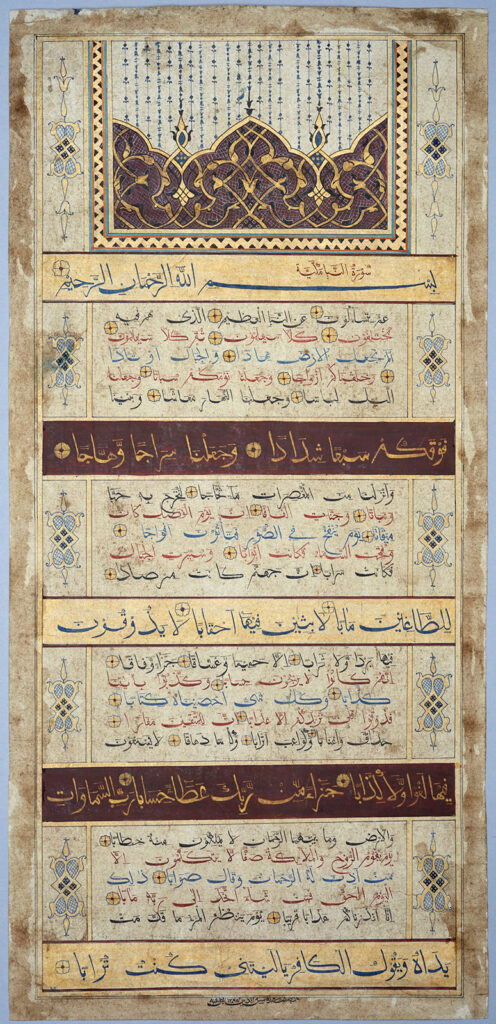
Calligraphic Panel of Surah 78 – Al-Naba’

MAN 470

Calligraphic panel featuring Surah 78 – Al-Naba’ (The Tidings), executed in the Bihārī script, a style of calligraphy characteristic of Qur’anic manuscripts produced in the Indian subcontinent.

The text is written in a harmonious alternation of three colors—black, red, and blue—creating a clear visual rhythm while enhancing the richness of the composition. The verses are marked with gilded rosettes, and the entire panel is framed by finely illuminated floral and geometric decorations, particularly in the heading and the lateral margins.

The work is signed by the scribe Muḥammad Shams al-Dīn and dated 1290 AH (1873 CE), bearing witness to the vitality of the art of Qur’anic calligraphy in the late nineteenth century and to the enduring tradition of manuscript production throughout the Islamic world.

Date: 1290 AH / 1873 CE
Complete Qur’an Manuscript

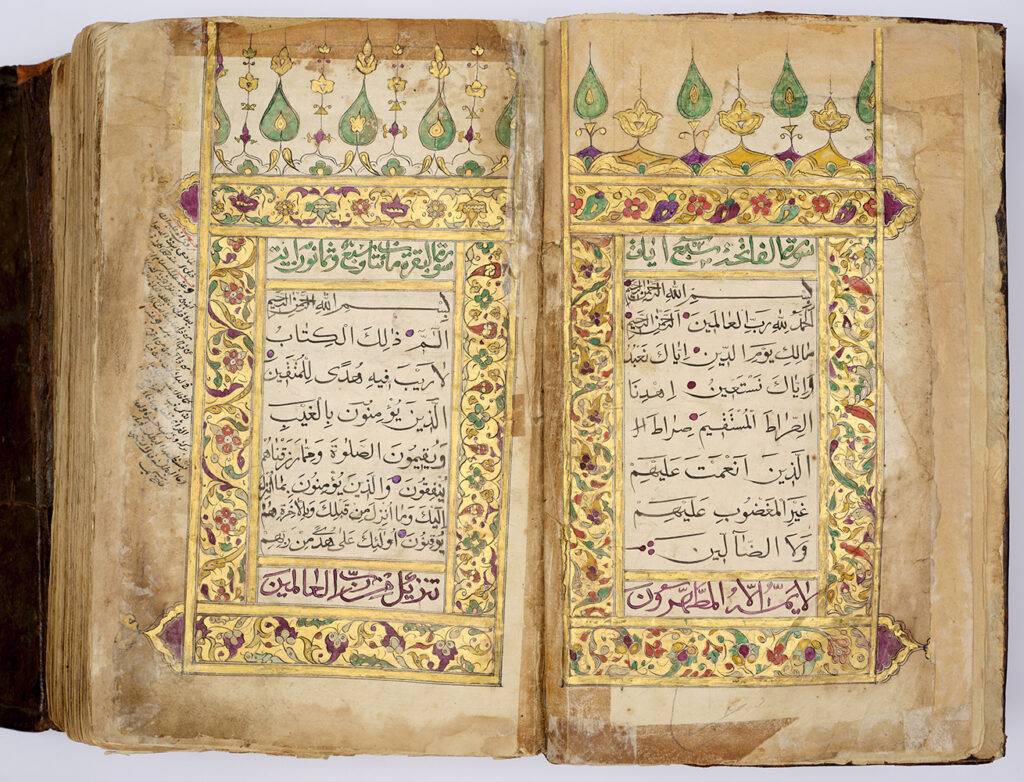
MAN 587

Complete handwritten Qur’an copied in 1290 AH (1872 CE), originating from Eastern Europe. The manuscript opens with a magnificent illuminated double-page spread featuring Surah 1 – Al-Fātiḥah (The Opening) and the beginning of Surah 2 – Al-Baqarah (The Cow).

The decorative frames are richly adorned with polychrome floral motifs and gold-highlighted geometric designs, characteristic of prestigious Qur’anic manuscript traditions. The text, meticulously calligraphed in black ink, is enhanced with vocalization marks and colored verse markers that facilitate reading while enriching the manuscript’s visual elegance.

Distinguished by the quality of its calligraphy, the richness of its illumination, and its excellent state of preservation, this manuscript bears witness to the enduring tradition of Islamic book arts in the late nineteenth century.

Date: 1290 AH / 1872 CE

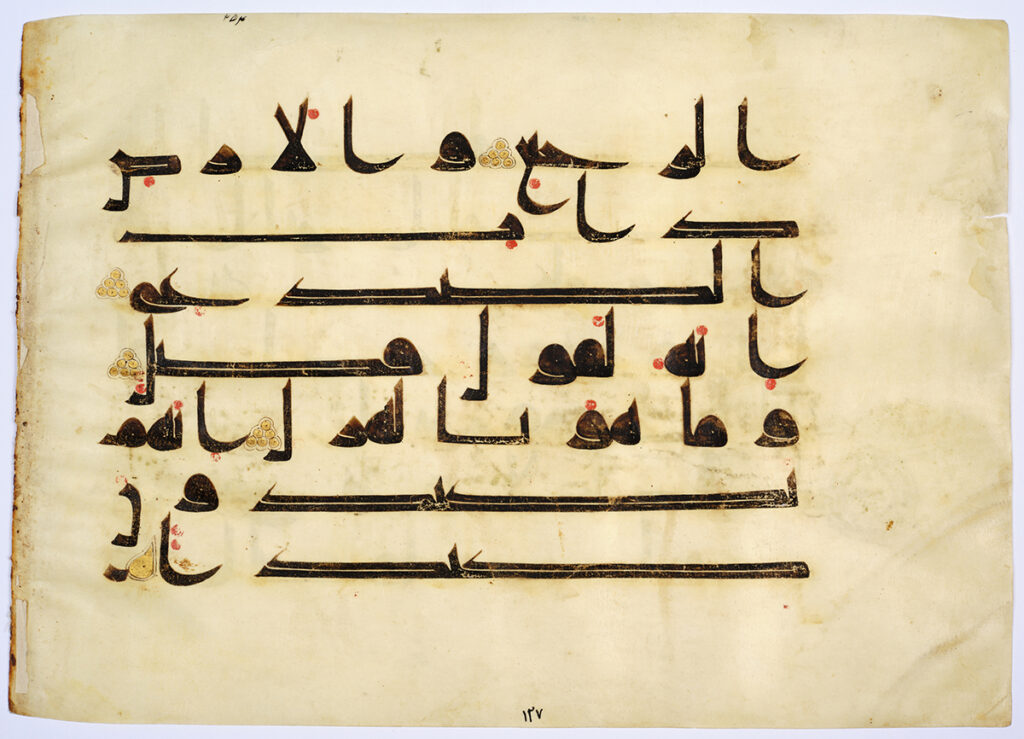
Quran Folio in Kufic Script on Parchment

MAN 338

This Quran folio, copied on parchment and probably dating from the 10th century, is written in early Kufic script. The letters, executed in black ink, are devoid of diacritical dots and full vocalization, in keeping with the conventions of the earliest Quranic manuscripts. Delicate red marks provide reading guidance, while small gilded medallions indicate the end of each verse.

The folio contains verses 11 to 15 of Surat At-Tāriq (The Night Visitor), which evoke the rain-bearing sky, the earth that splits open to bring forth life, and the power and truth of the Divine Word.

Through the sobriety of its script and the harmony of its composition, this manuscript bears witness to the earliest traditions of Quranic transmission, in which the clarity of the sacred text and the mastery of the calligrapher’s hand were of paramount importance.

Date: Probably 10th century.

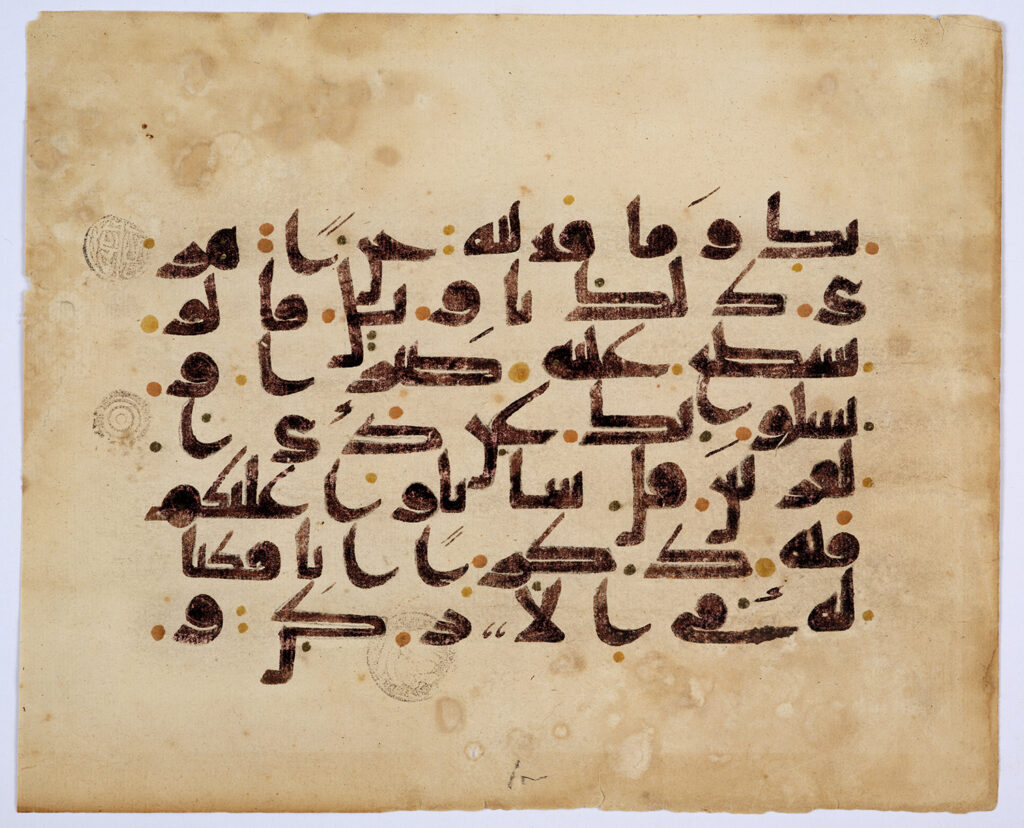
Qur’an Folio in Kufic Script

MAN 198

A Qur’an folio copied on paper in early Kufic script, distinguished by the absence of diacritical dots on the letters, in keeping with the practice of the earliest Qur’anic manuscripts. Reading the text is facilitated by an early system of colored dots indicating vowels and the principal vocalization marks, reflecting the first stages in the development of Arabic writing.

The folio contains verses 82 to 84 of Surat al-Kahf (The Cave), marking the transition between the account of Moses and al-Khiḍr and the beginning of the story of Dhul-Qarnayn. Through the sobriety of its script and the balanced composition of its layout, this manuscript illustrates the early development of the art of Qur’anic copying, when the clarity and legibility of the sacred text still took precedence over ornamentation.

Date: 14th–15th century.

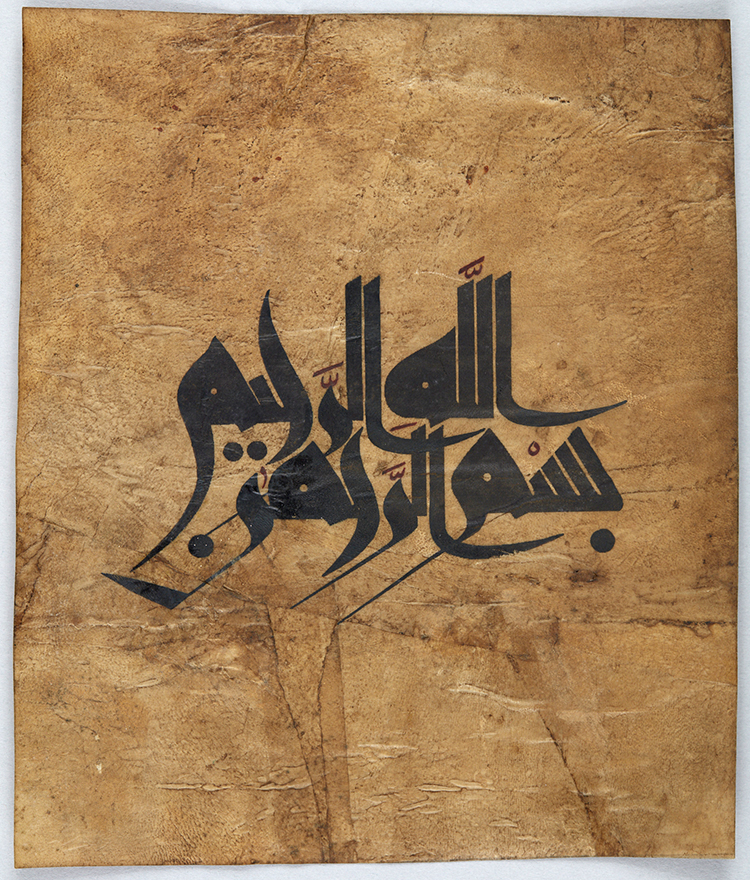
Calligraphed Basmala on Parchment

MAN 514

This calligraphic composition depicts the Basmala (Bismi Allāh al-Raḥmān al-Raḥīm — “In the name of God, the Most Compassionate, the Most Merciful”), executed on parchment. Written in black ink with remarkable mastery, the letters intertwine to form a monumental composition whose harmonious balance highlights the beauty of Arabic calligraphy.

The vocalization marks, rendered in red ink, subtly punctuate the text and create a harmonious contrast with the sobriety of the calligraphy. Through its simplicity and visual strength, this work illustrates the central place of the Basmala, the opening formula that introduces nearly every chapter of the Qur’an and has traditionally accompanied countless written works throughout Islamic civilization.

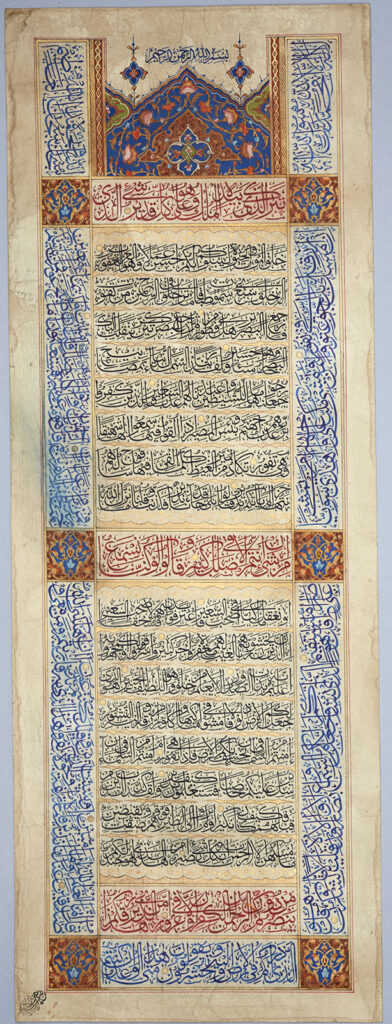
Calligraphic Panel of Surah 67 – Al-Mulk

MAN 418

A calligraphic panel featuring verses from Surah Al-Mulk (Tabārak), executed in elegant thuluth script. The text is arranged in a vertical composition framed by broad calligraphic bands and enhanced with remarkable illuminated decorations featuring vegetal and geometric motifs.

The headings and frames, rendered in red, blue, and gold ink, harmonize with a rich polychrome palette that highlights the majesty of the Qur’anic text. The gilded illuminations, inspired by the great ateliers of Islamic manuscript art, reflect the exceptional skill of calligraphers and illuminators in uniting writing with ornamentation.

At the intersection of calligraphy and illumination, this work exemplifies the central place of the Qur’an in the arts of Islam, where the beauty of the script plays an essential role in the transmission and contemplation of the sacred text.

Mamluk Qur’an – Ten Consecutive Folios

MAN 171

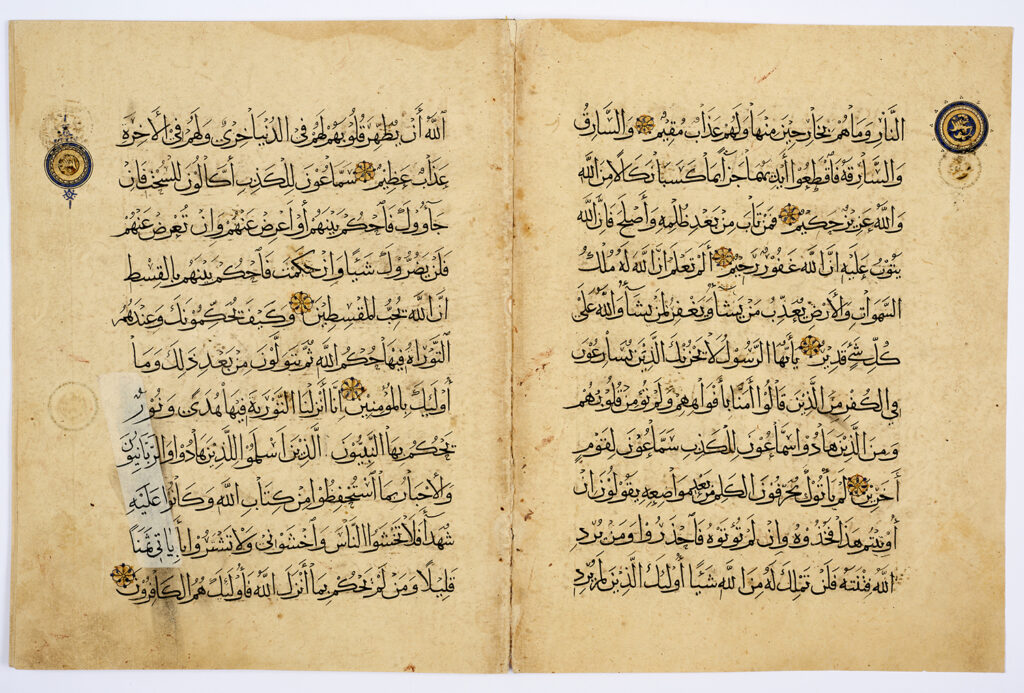
An exceptional set of ten consecutive folios from a Mamluk Qur’an produced in the Near East during the 14th century. Copied on paper in elegant muḥaqqaq script, the manuscript features eleven lines of text per page, punctuated by gilded rosettes marking the end of each verse.

The margins are decorated with blue circular medallions highlighted with gold, indicating groups of five and ten verses, while the surah headings are reserved in white on a blue panel adorned with floral arabesques and framed in gold. The folios preserve portions of Surat al-Māʾidah (The Table Spread) and Surat al-Anʿām (The Cattle), illustrating the refinement of the art of the book developed under the Mamluk dynasty.

Date: 14th century.

Calligraphic Panel of Surah 1 – Al-Fātiḥah and the Opening Verses of Surah 2 – Al-Baqarah

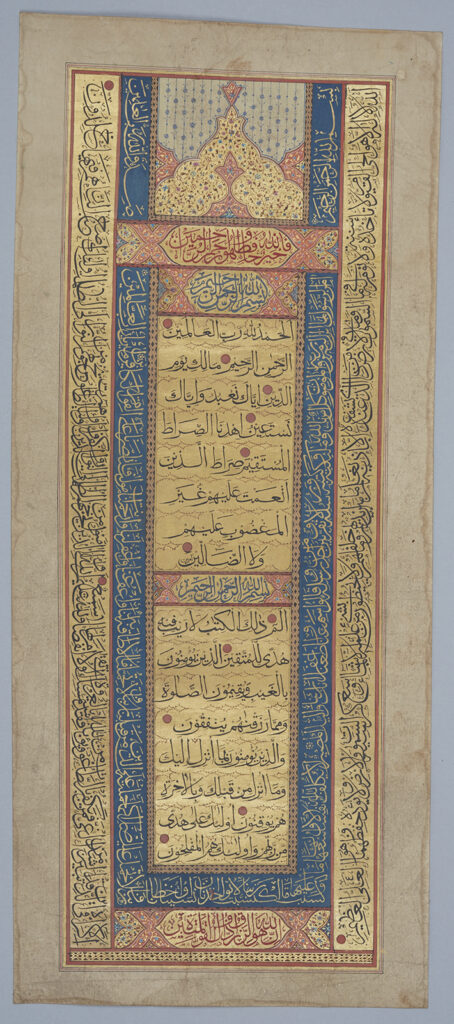
MAN 441

Calligraphic panel featuring Surah 1 – Al-Fātiḥah (The Opening) and the opening verses of Surah 2 – Al-Baqarah (The Cow). The main text is executed in naskhī script, renowned for its clarity and elegance, while the borders and marginal inscriptions are rendered in thuluth, creating a striking contrast between the two calligraphic styles. The surrounding frame is adorned with the celebrated Verse of the Throne (Āyat al-Kursī, Qur’an 2:255), whose calligraphy blends harmoniously with a richly illuminated decoration of floral and geometric motifs.

Four Large Qur’an Folios with Interlinear Persian Translation

MAN 331

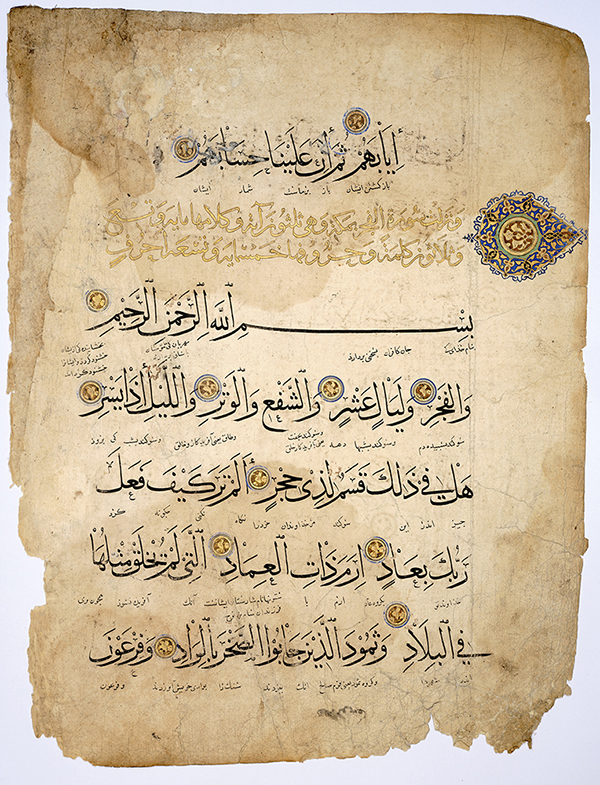
A set of four large folios from an ancient Qur’an, copied between the 9th and 10th centuries. The Qur’anic text is written in an elegant muḥaqqaq script in black ink, arranged in seven lines per page, and accompanied by an interlinear Persian translation inserted between the Arabic lines to facilitate understanding.

The manuscript is richly illuminated with gilded rosettes marking the end of each verse. The surah headings are executed in gold ink and include indications of the number of verses as well as whether each surah is Meccan or Medinan. In the margins, large blue medallions heightened with gold mark the beginning of the surahs, reflecting the refinement of Islamic book art and the exceptional skill of its illuminators.

By combining the Arabic Qur’anic text with an interlinear Persian translation, this manuscript illustrates the dissemination of the Qur’an throughout the Persian-speaking world and stands as a valuable testament to the transmission of Islamic knowledge and culture.

Date: 9th–10th century

Qur’an Page in Kūfic Script on Parchment

MAN 512

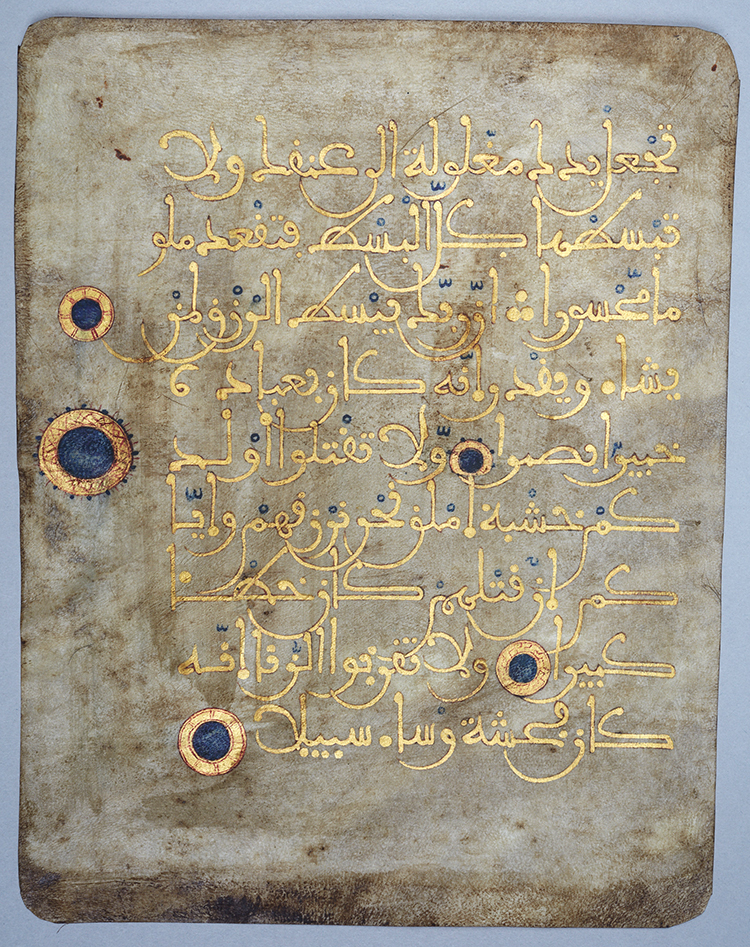
Qur’an page on parchment containing verses 29–32 of Sūrat al-Isrāʾ (The Night Journey), executed in Kūfic script with gold ink. The letters, rendered with remarkable restraint and clarity, stand out against the parchment, reflecting the elegance of the earliest Qur’anic manuscripts.

The verse endings are marked by large illuminated circular medallions in gold, red, and blue, which guide the reader through the text while enhancing the composition with a refined decorative dimension. Through the harmonious combination of monumental calligraphy, gold leaf, and parchment, this page exemplifies the artistic sophistication of the earliest luxury Qur’ans.

Illuminated Leaves from a Qur’an Manuscript

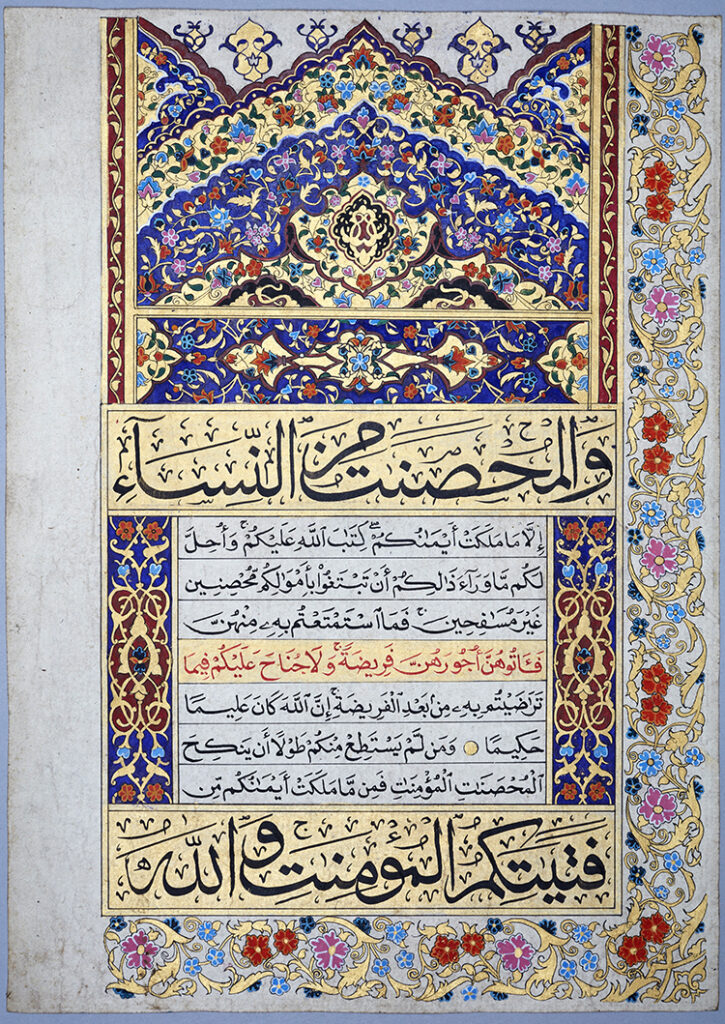
MAN 553

A set of eleven unbound leaves from a handwritten Qur’an manuscript. The first leaf is written on the recto only, while the remaining ten are calligraphed on both recto and verso. The text comprises verses 24 to 147 of Sūrat al-Nisāʾ (The Women).

The first two leaves are richly illuminated with floral compositions and multicolored arabesques enhanced with gold, reflecting the refinement of the Islamic art of the book. Each page contains sixteen lines: the first and last lines are executed in thuluth script, while the main text alternates between naskh script in black ink and naskh script in red ink. This carefully balanced layout lends the manuscript exceptional clarity, rhythm, and elegance.

Through the richness of its illumination and the mastery of its calligraphy, this ensemble exemplifies the high level of craftsmanship achieved by workshops specializing in the production of Qur’anic manuscripts.

Legal Information

Intellectual Property

All content available on this website, including but not limited to texts, photographs, manuscripts, images, illustrations, videos, digitized documents, logos, databases, graphic elements, and other materials, is protected under Swiss and international copyright and intellectual property laws.

Except with the prior written authorization of the ADLANIA Foundation or the relevant rights holders, any reproduction, representation, distribution, adaptation, or exploitation, whether in whole or in part, of this content, by any means or on any medium whatsoever, is prohibited.

The reproductions of the works and documents presented on this website are made available exclusively for purposes of preservation, research, scientific, cultural, and heritage enhancement.

Collections and Archives

The manuscripts, documents, photographs, heritage objects, works of art, and other collections presented on this website are owned by the ADLANIA Foundation or are reproduced with the authorization of their owners or rights holders.

The manuscripts, documents, photographs, heritage objects, works, and other collections presented on this website are owned by the ADLANIA Foundation or are reproduced with the authorization of their owners or rights holders.

Collection Photographs

The photographs of the manuscripts, objects, works of art, and other heritage items presented on this website were taken by photographer Abdou Diouri as part of his collaboration with the ADLANIA Foundation.

These photographs are protected by copyright.

Any reproduction, display, distribution, modification, or use, whether in whole or in part and in any form whatsoever, is prohibited without the prior written authorization of the ADLANIA Foundation and, where applicable, the relevant rights holders.

Privacy Policy

The ADLANIA Foundation is committed to protecting the personal data of visitors to this website. The information collected through contact forms, information requests, registrations, or orders is used exclusively to respond to users' inquiries, manage communications, process orders, and improve the services provided.

Personal data is neither sold, rented, nor disclosed to third parties, except where required by law or when necessary for the provision of a service requested by the user.

In accordance with applicable data protection legislation, each user has the right to access, rectify, erase, restrict the processing of, and, where applicable, object to the processing of their personal data.

Any request may be addressed to the ADLANIA Foundation using the contact details provided on the website.

Cookie Policy

This website uses cookies to ensure its proper functioning, enhance the browsing experience, and, where applicable, measure website traffic.

Strictly necessary cookies required for the operation of the website are placed automatically. Other categories of cookies, including those used for audience measurement or provided by third-party services, are only used after the user's consent has been obtained, where required by applicable law.

The user may, at any time, manage or withdraw their consent through their browser settings or via the cookie consent manager, where available.

Legal Information

Intellectual Property

All content available on this website, including but not limited to texts, photographs, manuscripts, images, illustrations, videos, digitized documents, logos, databases, graphic elements, and other materials, is protected under Swiss and international copyright and intellectual property laws.

Except with the prior written authorization of the ADLANIA Foundation or the relevant rights holders, any reproduction, representation, distribution, adaptation, or exploitation, whether in whole or in part, of this content, by any means or on any medium whatsoever, is prohibited.

The reproductions of the works and documents presented on this website are made available exclusively for purposes of preservation, research, scientific, cultural, and heritage enhancement.

Collections and Archives

The manuscripts, documents, photographs, heritage objects, works of art, and other collections presented on this website are owned by the ADLANIA Foundation or are reproduced with the authorization of their owners or rights holders.

The manuscripts, documents, photographs, heritage objects, works, and other collections presented on this website are owned by the ADLANIA Foundation or are reproduced with the authorization of their owners or rights holders.

Collection Photographs

The photographs of the manuscripts, objects, works of art, and other heritage items presented on this website were taken by photographer Abdou Diouri as part of his collaboration with the ADLANIA Foundation.

These photographs are protected by copyright.

Any reproduction, display, distribution, modification, or use, whether in whole or in part and in any form whatsoever, is prohibited without the prior written authorization of the ADLANIA Foundation and, where applicable, the relevant rights holders.

Privacy Policy

The ADLANIA Foundation is committed to protecting the personal data of visitors to this website. The information collected through contact forms, information requests, registrations, or orders is used exclusively to respond to users' inquiries, manage communications, process orders, and improve the services provided.

Personal data is neither sold, rented, nor disclosed to third parties, except where required by law or when necessary for the provision of a service requested by the user.

In accordance with applicable data protection legislation, each user has the right to access, rectify, erase, restrict the processing of, and, where applicable, object to the processing of their personal data.

Any request may be addressed to the ADLANIA Foundation using the contact details provided on the website.

Cookie Policy

This website uses cookies to ensure its proper functioning, enhance the browsing experience, and, where applicable, measure website traffic.

Strictly necessary cookies required for the operation of the website are placed automatically. Other categories of cookies, including those used for audience measurement or provided by third-party services, are only used after the user's consent has been obtained, where required by applicable law.

The user may, at any time, manage or withdraw their consent through their browser settings or via the cookie consent manager, where available.