Sufism

Manuscripts devoted to Sufism constitute an exceptional testimony to the spiritual, intellectual, and cultural life of the Muslim world. Since the earliest centuries of Islam, they have preserved and transmitted the teachings of spiritual masters, ethical treatises, commentaries on the Qur’an and the Hadith, as well as accounts of wisdom that have guided generations of seekers of knowledge.

This manuscript tradition also includes numerous collections of praises to the Prophet Muḥammad ﷺ, spiritual poetry, supplications (*duʿāʾ*), litanies (*awrād*), compilations of *dhikr*, and texts intended for spiritual education and inner refinement. Written in both prose and verse, these works bear witness to the literary richness of the Sufi heritage and to the central place of love for the Prophet within the Islamic spiritual tradition.

Copied with great care, these manuscripts reflect the importance attached to the faithful transmission of knowledge. They also reveal the richness of the Islamic manuscript tradition, in which the beauty of calligraphy, illumination, and bookbinding accompanies an intellectual heritage of profound spiritual significance.

Preserved in libraries, zawiyas (Sufi lodges), and private collections throughout the Muslim world, these manuscripts testify to the diversity of Sufi schools and the cultural exchanges that have shaped the history of Islamic thought. Through this collection, the ADLANIA Foundation highlights a manuscript heritage of remarkable historical and cultural value, helping to preserve and transmit a tradition that has profoundly influenced Islamic civilization and continues to inspire researchers, historians, and admirers of the written heritage.

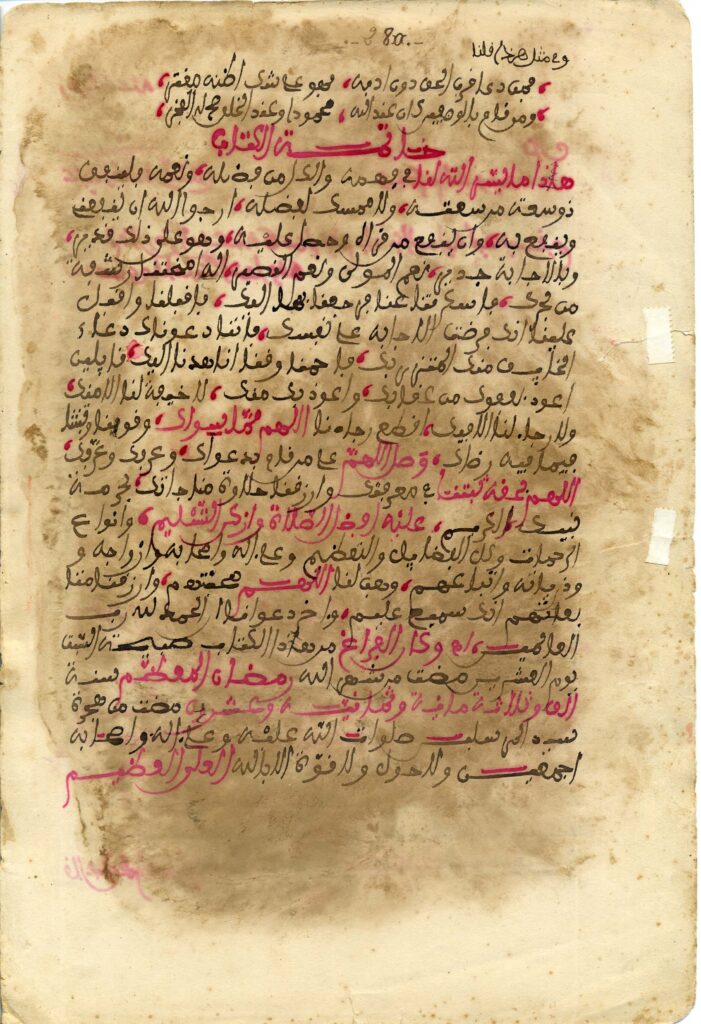
Al-Mawādd al-Ġaythiyya al-Nāshiʾa ʿan al-Ḥikam al-Ġawthiyya

MAN 294

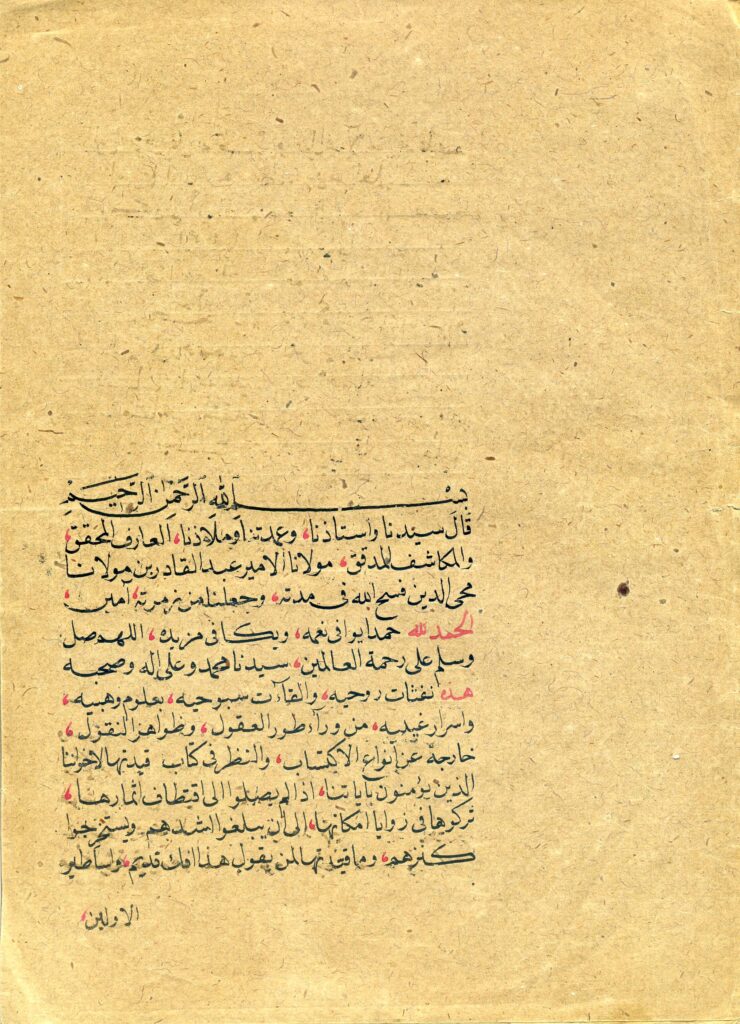
Complete manuscript of Al-Mawādd al-Ġaythiyya al-Nāshiʾa ʿan al-Ḥikam al-Ġawthiyya, a spiritual work by Shaykh Aḥmad b. Muṣṭafā al-ʿAlāwī al-Mustaġānimī (1874–1934), one of the foremost figures of the revival of Sufism in the Maghreb during the early twentieth century. This work brings together teachings devoted to spiritual education, inner purification, and the knowledge of God, in continuity with the initiatic tradition of the Shādhiliyya-Darqāwiyya order.

This copy, dated 1328 AH / 1909 CE, contains both parts of the work in a single volume. The text is written in Maghribi script in black ink, while the titles, subtitles, and highlighted words are inscribed in red ink, following a presentation characteristic of Maghrebi manuscripts intended for study and transmission.

Title: Al-Mawādd al-Ġaythiyya al-Nāshiʾa ʿan al-Ḥikam al-Ġawthiyya

Author: Shaykh Aḥmad b. Muṣṭafā al-ʿAlāwī al-Mustaġānimī Muṣṭafā al-ʿAlāwī al-Mustaġānimī

Date: 1328 AH / 1909 CE
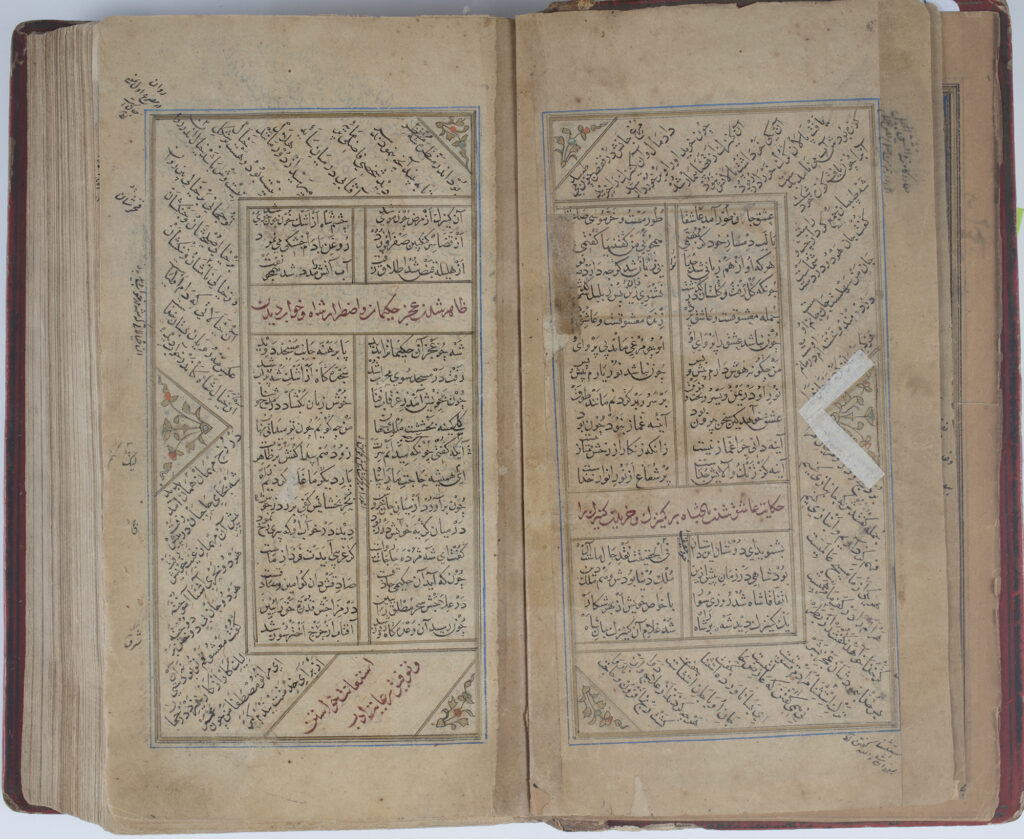
Mathnawī-ye Maʿnawī (The Spiritual Poem)

MAN 195

Complete manuscript of the Mathnawī-ye Maʿnawī, the major work of the Sufi master Jalāl al-Dīn Rūmī (d. 1273). A true masterpiece of Persian literature and Islamic spirituality, the Mathnawī brings together stories, parables, and teachings intended to guide the reader on the path toward the knowledge of God and inner purification.

Copied in eastern Iran during the Timurid period (15th century), the manuscript is written in Persian and preceded by an Arabic preface. It contains all six books (daftars) of the work in their entirety. The main text is copied in black naskhī script, while the margins contain commentaries written diagonally, reflecting the refined page layout characteristic of Persian manuscripts.

The manuscript opens with a richly illuminated double-page frontispiece executed in polychrome and gold. Polylobed medallions, inscribed in white script, bear the title of the work, the name of Jalāl al-Dīn Rūmī, and that of Muḥammad Tabrīzī, who is also mentioned in the decorative program. Each book begins with an illuminated double frontispiece featuring ornamental cartouches (sarlowḥ), scrolling arabesques, and marginal cornerpieces (latchak), enhanced with floral motifs and gilding. The later binding, produced in Kashmir, is made of painted and lacquered papier-mâché decorated with floral designs.

Title: Mathnawī-ye Maʿnawī (The Spiritual Poem)

Author: Jalāl al-Dīn Rūmī (d. 1273)

Date: 15th century (Timurid period)

Al-Ḥiṣn al-Ḥaṣīn

MAN 145

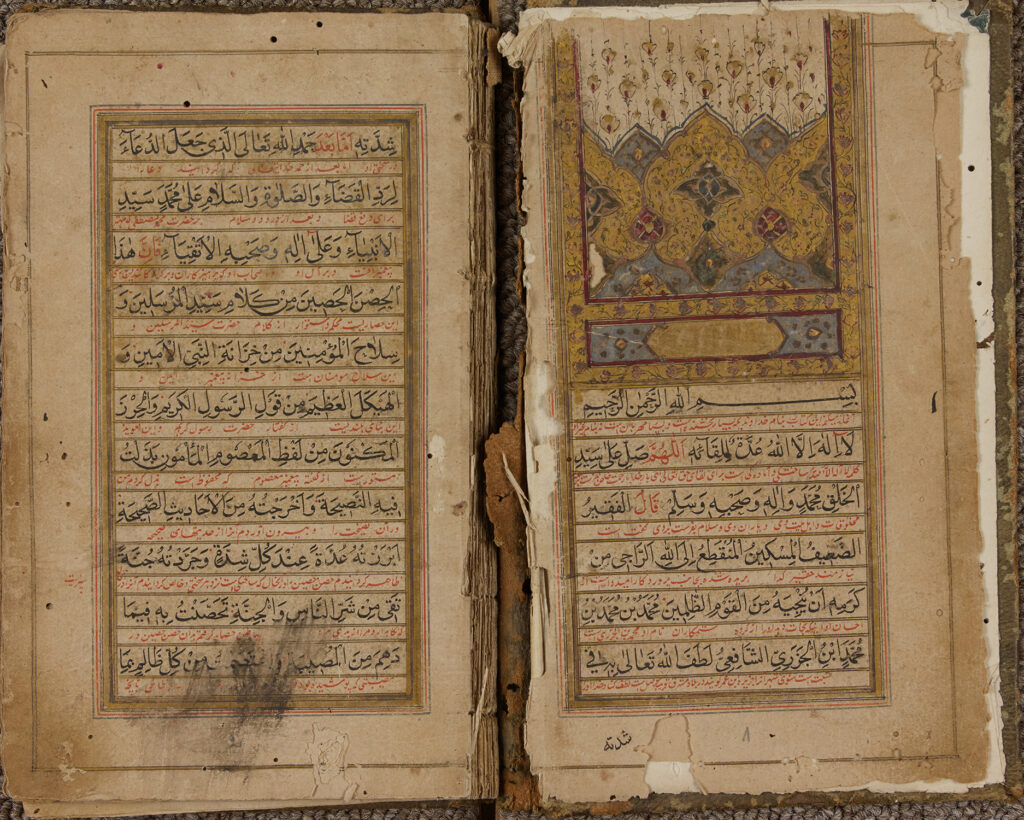
Manuscript of al-Ḥiṣn al-Ḥaṣīn (The Impenetrable Fortress), the celebrated collection of prayers, supplications (duʿāʾ), and protective invocations compiled by Muḥammad ibn al-Jazarī al-Shāfiʿī (1350–1429), the renowned traditionist and specialist in the canonical Qurʾānic readings. The work brings together invocations drawn from the Qurʾān and the Prophetic tradition, intended to accompany believers throughout the various moments of daily life.

The manuscript is copied in elegant naskh script in black ink, with an interlinear Persian translation written in red ink, reflecting its use in Persian-speaking communities. Its opening folios are embellished with polychrome illuminations and decorative frames, illustrating the great care devoted to the production of this devotional work.

Widely circulated throughout the Muslim world, al-Ḥiṣn al-Ḥaṣīn remains a landmark of Islamic devotional literature and an enduring witness to the transmission of spiritual practices across the centuries.

Title: Al-Ḥiṣn al-Ḥaṣīn (The Impenetrable Fortress)

Author: Muḥammad ibn al-Ğazarī al-Šāfiʿī

Kitāb al-Mawāqif (The Book of Spiritual Stations)

MAN 37

Manuscript of Kitāb al-Mawāqif (The Book of Spiritual Stations), the major work of Emir ʿAbd al-Qādir ibn Muḥyī al-Dīn al-Jazāʾirī (1808–1883), the celebrated Algerian resistance leader, Sufi master, and thinker. Regarded as the culmination of his spiritual thought, this work brings together teachings devoted to the knowledge of God, the purification of the soul, and the metaphysical realities of the Sufi tradition.

The Fondation ADLANIA collection includes the three volumes of this work, copied in a clear and elegant naskhī script, in black ink with red rubrication used to highlight specific passages and textual divisions. The manuscript was copied by Yaḥyā ibn Muḥammad al-Zinātī al-Jazāʾirī and bears witness to the dissemination of Emir Abd el-Kader’s thought among Algerian scholarly circles during the late nineteenth century.

The illustration presented here shows the first volume of this manuscript collection.

Title: Kitāb al-Mawāqif (The Book of Spiritual Stations)

Author: Emir ʿAbd al-Qādir ibn Muḥyī al-Dīn al-Jazāʾirī

Scribe: Yaḥyā ibn Muḥammad al-Zinātī al-Jazāʾirī

Date: 19th century

Extent: 254 folios (Volume I)

Al-Ḥamziyya

MAN 27

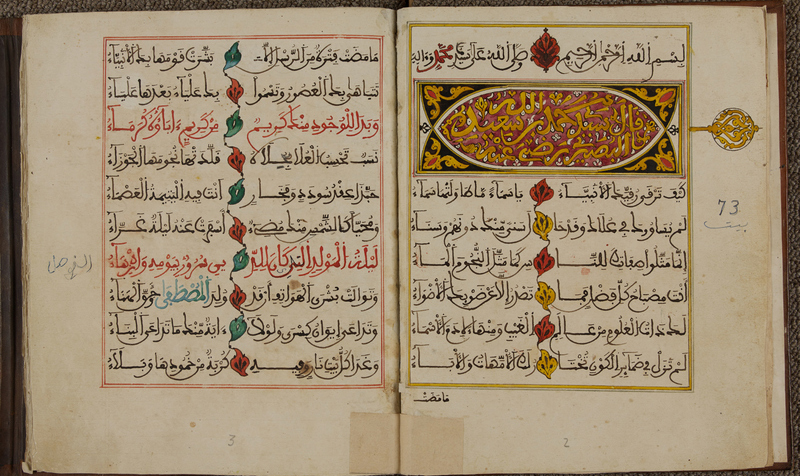
Manuscript of the Ḥamziyya, the celebrated poem in praise of the Prophet Muḥammad ﷺ composed by Muḥammad ibn Saʿīd al-Būṣayrī (1213–1294), one of the greatest mystical poets of the Islamic tradition. Widely circulated throughout the Muslim world, this work extols the virtues of the Prophet and holds a prominent place in spiritual literature and devotional practice.

The manuscript is richly illuminated and reflects the exceptional care devoted to its production. The title of the work is inscribed in gold letters within a red cartouche framed by polychrome ornamental motifs. The text is copied primarily in black ink, with red, green, and yellow inks used to highlight selected verses, names, and decorative elements. The hemistiches are separated by floral motifs in red, yellow, green, blue, and black, creating a harmonious balance between calligraphy and illumination on every page.

The manuscript is further distinguished by the presence, in its final three folios, of an illuminated representation of the Two Holy Sanctuaries (al-Ḥaramayn al-Šarīfayn), depicting the Kaaba in Mecca and the Prophet’s Mosque in Medina. An accompanying inscription reads: “This is the representation of the Two Holy Sanctuaries: the Sacred House of God and the Rawḍa of the Prophet—peace and blessings be upon him—together with his two companions, Abū Bakr and ʿUmar, may God be pleased with them.” This illustration enhances both the artistic and devotional significance of the manuscript.

Title: Al-Ḥamziyya

Author: Muḥammad ibn Saʿīd al-Būṣayrī

Date: 19th century

Extent: 25 folios

Al-Ibrīz

MAN 104

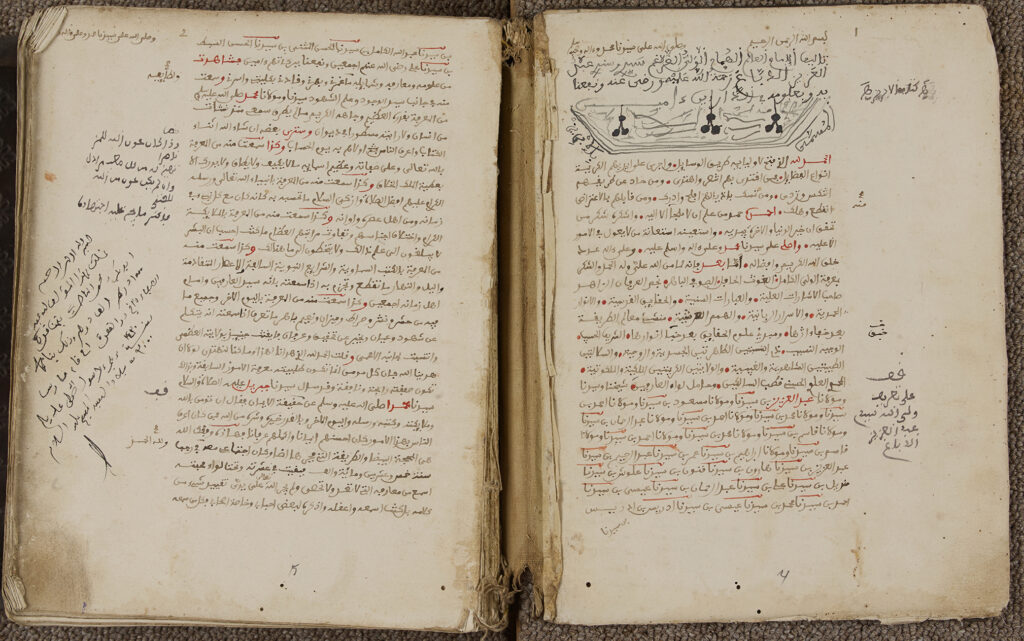
Manuscript of Al-Ibrīz, the work of Aḥmad ibn Mubārak al-Sijilmāsī al-Lamṭī (d. 1743), which brings together the spiritual teachings of his master, Sidi ʿAbd al-ʿAzīz al-Dabbāgh (d. 1719), one of the foremost figures of Moroccan Sufism. The work records the master’s sayings, conversations, and teachings as collected by his disciple, addressing themes such as the knowledge of God, purification of the soul, ethics, and spiritual realization.

The manuscript was copied by Muḥammad al-Faḍl ibn Muḥammad ibn Zarūq al-Sharīf al-Jabbār al-Ḥasanī al-ʿArāʾishī and completed on 12 Ṣafar 1276 AH (10 September 1859). The text is written in naskh script, in black ink with red rubrication highlighting the divisions and selected passages.

The manuscript opens with a poem in praise of Al-Ibrīz, followed by a table of contents outlining the principal chapters of the work. It concludes with a detailed table of contents and a poem entitled al-Raʿdiyya, further enhancing the literary and spiritual significance of this copy.

Title: Al-Ibrīz

Author: Aḥmad ibn Mubārak al-Sijilmāsī al-Lamṭī

Scribe: Muḥammad al-Faḍl ibn Muḥammad ibn Zarūq al-Šarīf al-Ǧabār al-Ḥasanī al-ʿArāʾišī

Date of Copy: 12 Ṣafar 1276 AH / 10 September 1859

Extent: 276 folios

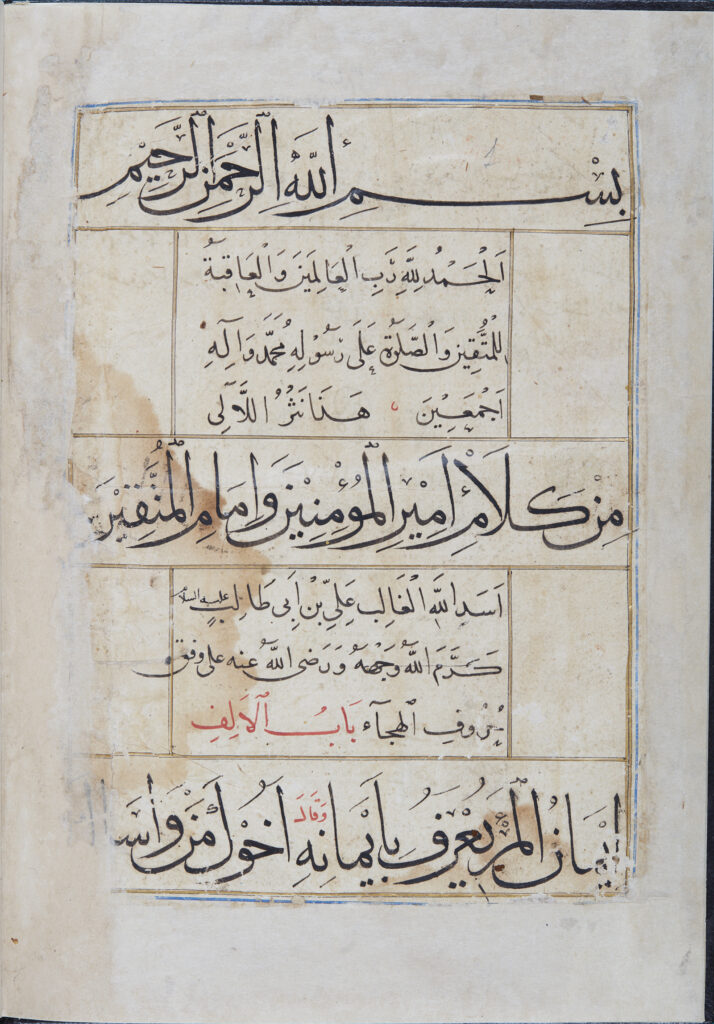
Naṯr al-Laʾālī min Kalām ʿAlī ibn Abī Ṭālib

MAN 191

Manuscript of *Naṯr al-Laʾālī min Kalām ʿAlī ibn Abī Ṭālib* (*The Pearls of the Sayings of Imam ʿAlī*), a poetic work by Ḥusayn Muḥammad Efendi Ḥusayn, inspired by the sayings and maxims attributed to Imam ʿAlī ibn Abī Ṭālib. The work renders into verse teachings of wisdom, ethics, and spirituality, offering both a literary and moral interpretation of this enduring legacy.

Copied in the Near East between the 16th and 17th centuries, the manuscript is written on paper in naskhī script, alternating with large lines in muḥaqqaq, executed in black ink with red highlights and framed by gold-ruled borders. The opening page bears the title of the work, together with the names and seals of several former owners, attesting to its history and transmission.

The manuscript is divided into two parts. The first concludes with a statement marking the end of *Naṯr al-Laʾālī*, while the second opens with a blessing upon the Prophet Muḥammad ﷺ and also bears the seal of a former owner. The volume is preserved in a modern black leather binding, decorated with a central mandorla with pendants and gilt vegetal (sāz) motifs.

Title: Naṯr al-Laʾālī min Kalām ʿAlī ibn Abī Ṭālib (The Pearls of the Sayings of Imam ʿAlī)

Author : Ḥusayn Muḥammad Efendi Ḥusayn

Date: 16th–17th century

Legal Information

Intellectual Property

All content available on this website, including but not limited to texts, photographs, manuscripts, images, illustrations, videos, digitized documents, logos, databases, graphic elements, and other materials, is protected under Swiss and international copyright and intellectual property laws.

Except with the prior written authorization of the ADLANIA Foundation or the relevant rights holders, any reproduction, representation, distribution, adaptation, or exploitation, whether in whole or in part, of this content, by any means or on any medium whatsoever, is prohibited.

The reproductions of the works and documents presented on this website are made available exclusively for purposes of preservation, research, scientific, cultural, and heritage enhancement.

Collections and Archives

The manuscripts, documents, photographs, heritage objects, works of art, and other collections presented on this website are owned by the ADLANIA Foundation or are reproduced with the authorization of their owners or rights holders.

The manuscripts, documents, photographs, heritage objects, works, and other collections presented on this website are owned by the ADLANIA Foundation or are reproduced with the authorization of their owners or rights holders.

Collection Photographs

The photographs of the manuscripts, objects, works of art, and other heritage items presented on this website were taken by photographer Abdou Diouri as part of his collaboration with the ADLANIA Foundation.

These photographs are protected by copyright.

Any reproduction, display, distribution, modification, or use, whether in whole or in part and in any form whatsoever, is prohibited without the prior written authorization of the ADLANIA Foundation and, where applicable, the relevant rights holders.

Privacy Policy

The ADLANIA Foundation is committed to protecting the personal data of visitors to this website. The information collected through contact forms, information requests, registrations, or orders is used exclusively to respond to users' inquiries, manage communications, process orders, and improve the services provided.

Personal data is neither sold, rented, nor disclosed to third parties, except where required by law or when necessary for the provision of a service requested by the user.

In accordance with applicable data protection legislation, each user has the right to access, rectify, erase, restrict the processing of, and, where applicable, object to the processing of their personal data.

Any request may be addressed to the ADLANIA Foundation using the contact details provided on the website.

Cookie Policy

This website uses cookies to ensure its proper functioning, enhance the browsing experience, and, where applicable, measure website traffic.

Strictly necessary cookies required for the operation of the website are placed automatically. Other categories of cookies, including those used for audience measurement or provided by third-party services, are only used after the user's consent has been obtained, where required by applicable law.

The user may, at any time, manage or withdraw their consent through their browser settings or via the cookie consent manager, where available.

Legal Information

Intellectual Property

All content available on this website, including but not limited to texts, photographs, manuscripts, images, illustrations, videos, digitized documents, logos, databases, graphic elements, and other materials, is protected under Swiss and international copyright and intellectual property laws.

Except with the prior written authorization of the ADLANIA Foundation or the relevant rights holders, any reproduction, representation, distribution, adaptation, or exploitation, whether in whole or in part, of this content, by any means or on any medium whatsoever, is prohibited.

The reproductions of the works and documents presented on this website are made available exclusively for purposes of preservation, research, scientific, cultural, and heritage enhancement.

Collections and Archives

The manuscripts, documents, photographs, heritage objects, works of art, and other collections presented on this website are owned by the ADLANIA Foundation or are reproduced with the authorization of their owners or rights holders.

The manuscripts, documents, photographs, heritage objects, works, and other collections presented on this website are owned by the ADLANIA Foundation or are reproduced with the authorization of their owners or rights holders.

Collection Photographs

The photographs of the manuscripts, objects, works of art, and other heritage items presented on this website were taken by photographer Abdou Diouri as part of his collaboration with the ADLANIA Foundation.

These photographs are protected by copyright.

Any reproduction, display, distribution, modification, or use, whether in whole or in part and in any form whatsoever, is prohibited without the prior written authorization of the ADLANIA Foundation and, where applicable, the relevant rights holders.

Privacy Policy

The ADLANIA Foundation is committed to protecting the personal data of visitors to this website. The information collected through contact forms, information requests, registrations, or orders is used exclusively to respond to users' inquiries, manage communications, process orders, and improve the services provided.

Personal data is neither sold, rented, nor disclosed to third parties, except where required by law or when necessary for the provision of a service requested by the user.

In accordance with applicable data protection legislation, each user has the right to access, rectify, erase, restrict the processing of, and, where applicable, object to the processing of their personal data.

Any request may be addressed to the ADLANIA Foundation using the contact details provided on the website.

Cookie Policy

This website uses cookies to ensure its proper functioning, enhance the browsing experience, and, where applicable, measure website traffic.

Strictly necessary cookies required for the operation of the website are placed automatically. Other categories of cookies, including those used for audience measurement or provided by third-party services, are only used after the user's consent has been obtained, where required by applicable law.

The user may, at any time, manage or withdraw their consent through their browser settings or via the cookie consent manager, where available.